Manual vs Automatic vs CVT vs Dual-Clutch: Which Is Fastest? (Redlined 101, Ep 25)
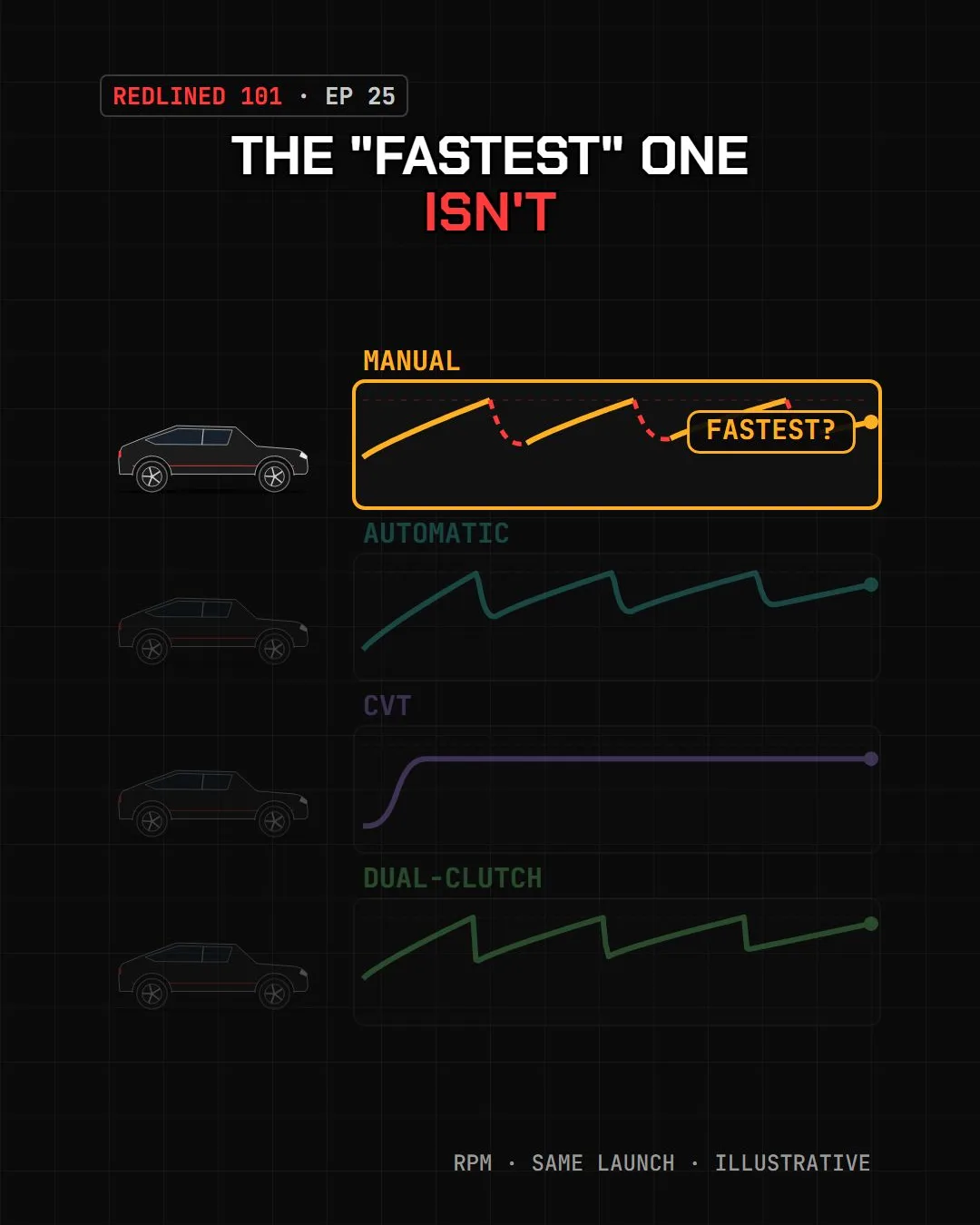
Manual, automatic, CVT, or dual-clutch? Same car, same launch. Watch the tach. Three of them drop at every shift. One never moves. And the one most people swear is fastest, isn't. Here's how each gearbox actually works, which one wins the race to sixty, and the catch with every one of them.
Watch Redlined 101, Ep 25 on Instagram →
Why a car needs a gearbox at all
An engine only makes useful power in a band of rpm, but the wheels need to go from standing still to highway speed. The gearbox sits between them and changes the ratio: a short gear to get moving, taller gears to cruise. All four of these do that job. They just do it very differently.
#1: The manual
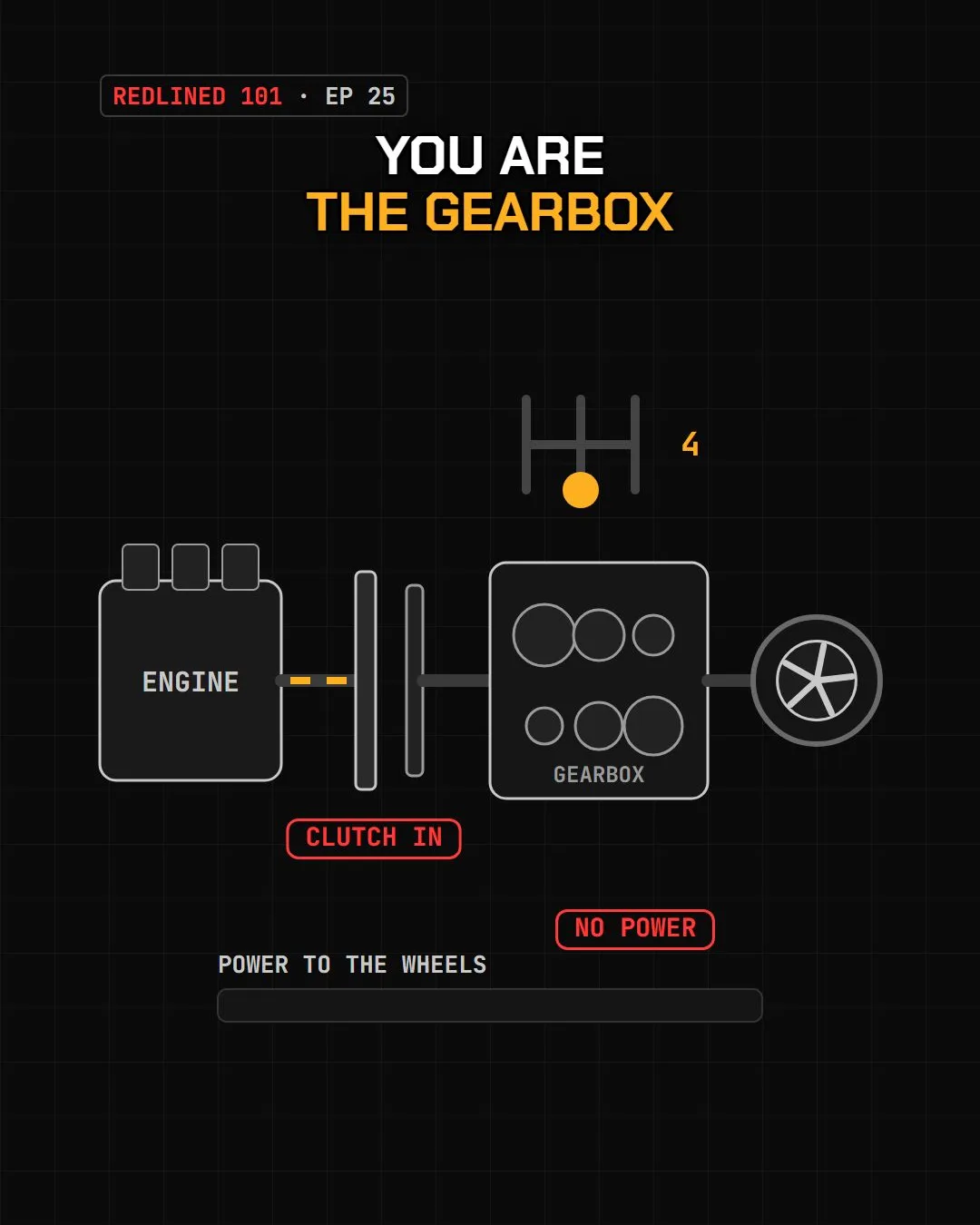
First, the manual. You are the gearbox.
- Clutch in, and the engine lets go of the wheels: the clutch separates the spinning engine from the gearbox.
- Pick the gear with the shifter.
- Clutch out, and the engine drives the wheels again.
Every shift, the power stops for a moment, even with fast hands. On the tach, that's the drop at each shift. We went deeper on the stick itself in manual vs paddle shift.
#2: The automatic
The automatic has no clutch pedal. So how does it sit in drive at a red light without stalling?
The torque converter
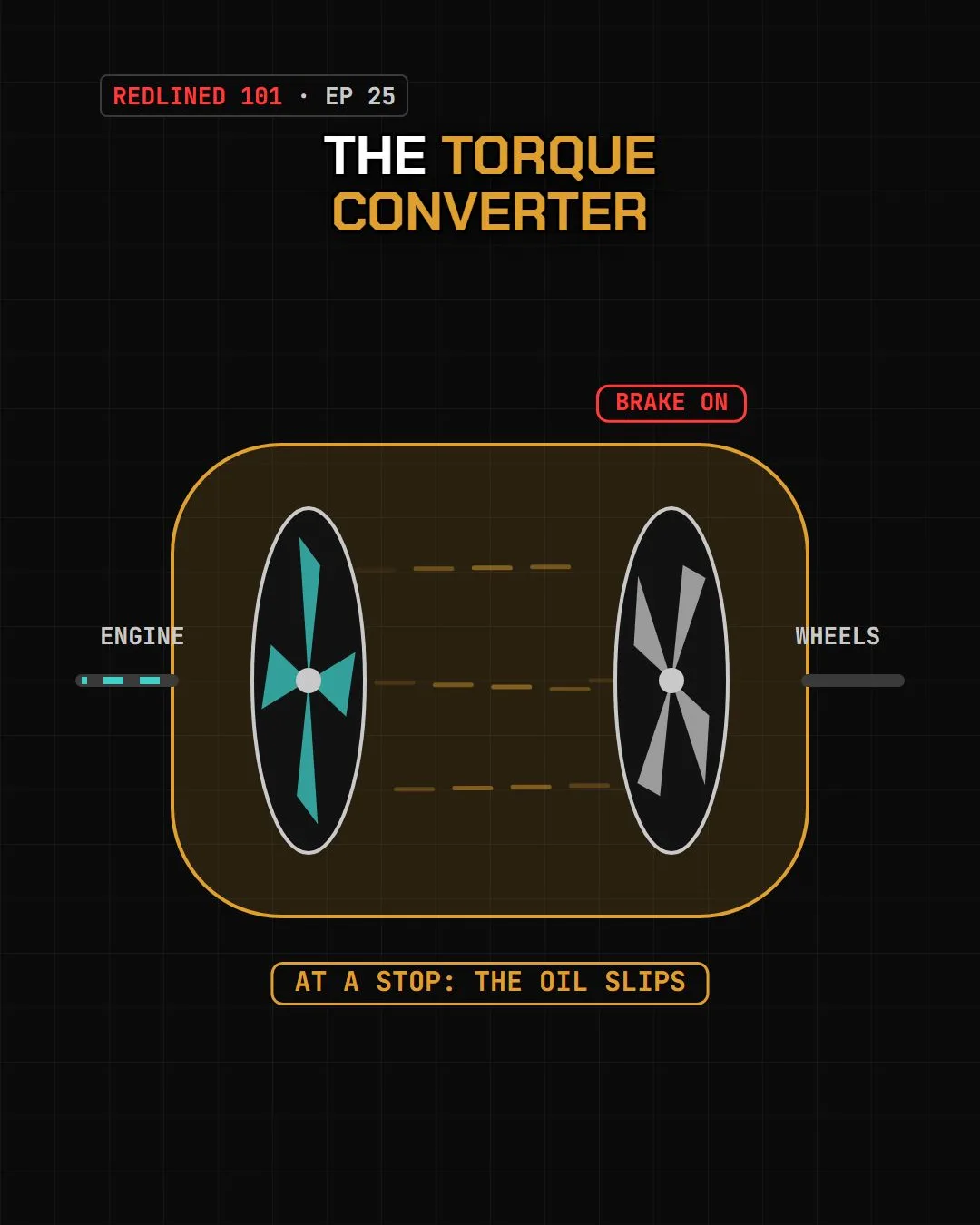
Picture two fans facing each other. Switch one on, and its wind spins the other. That's a torque converter, with oil instead of air. One side is turned by the engine; the other drives the gearbox.
- At a stop, with your foot on the brake, the oil just slips between the two halves. The engine keeps idling and nothing stalls.
- Step on it, the engine side spins faster, and the oil grabs, dragging the other side along.
The planetary gears
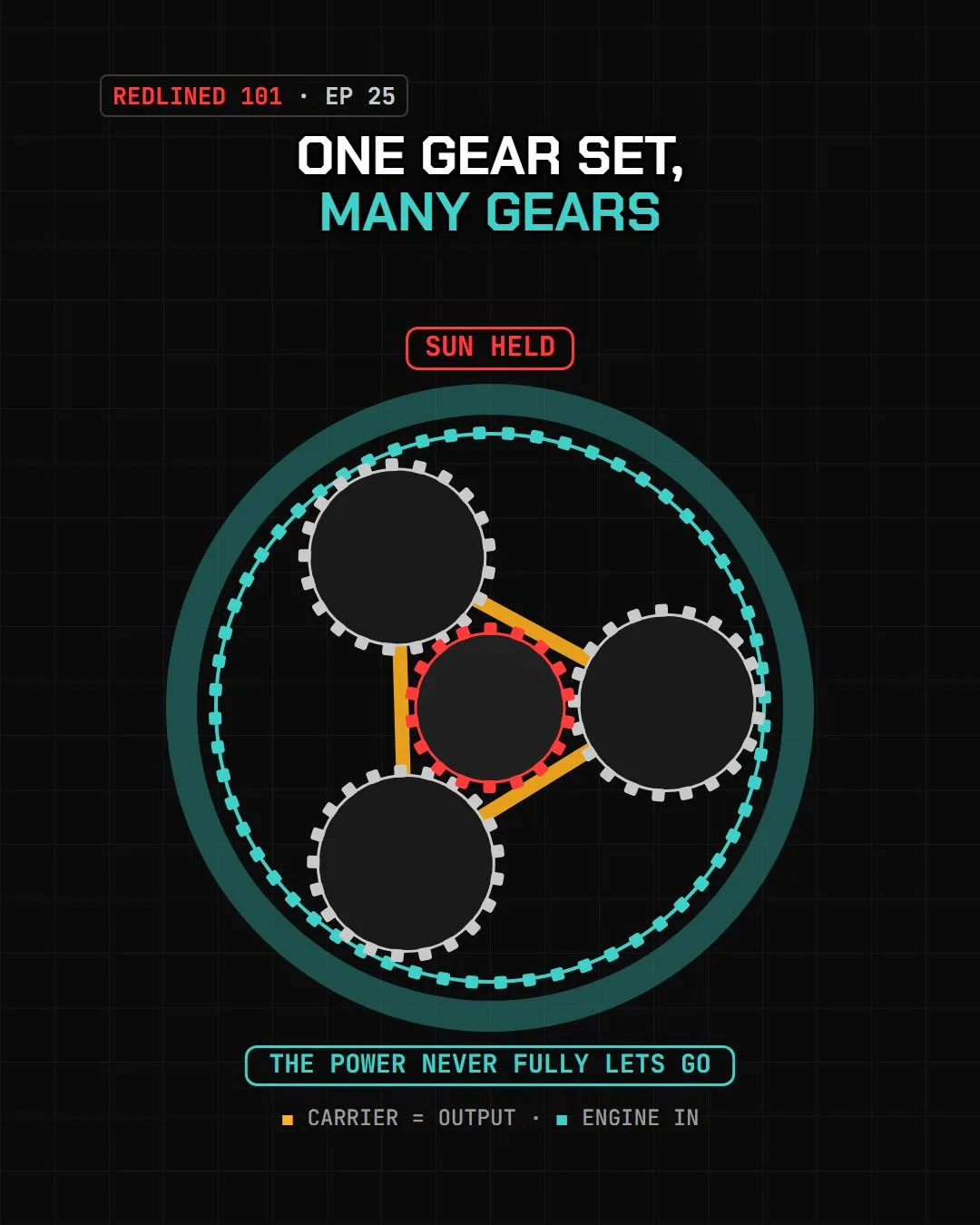
The gears behind it are a planetary set: a sun gear in the middle, planets around it, and a ring around them. All three are always in mesh.
- Hold the ring, and you get one gear.
- Hold the sun, and you get another.
A shift is just clutches swapping what's held. One lets go as the next one grabs, so the power never fully lets go. Real gearboxes combine more than one of these sets to get all their speeds, but every shift works this way.
#3: The CVT
The CVT (continuously variable transmission) has no gears at all. Just two pulleys and one belt.
Each pulley is two cones facing each other, with the belt running in the groove between them.
- Squeeze the cones together, and the belt is pushed outward: it rides higher, on a bigger circle.
- Spread them apart, and it drops into the groove: it rides lower, on a smaller circle.
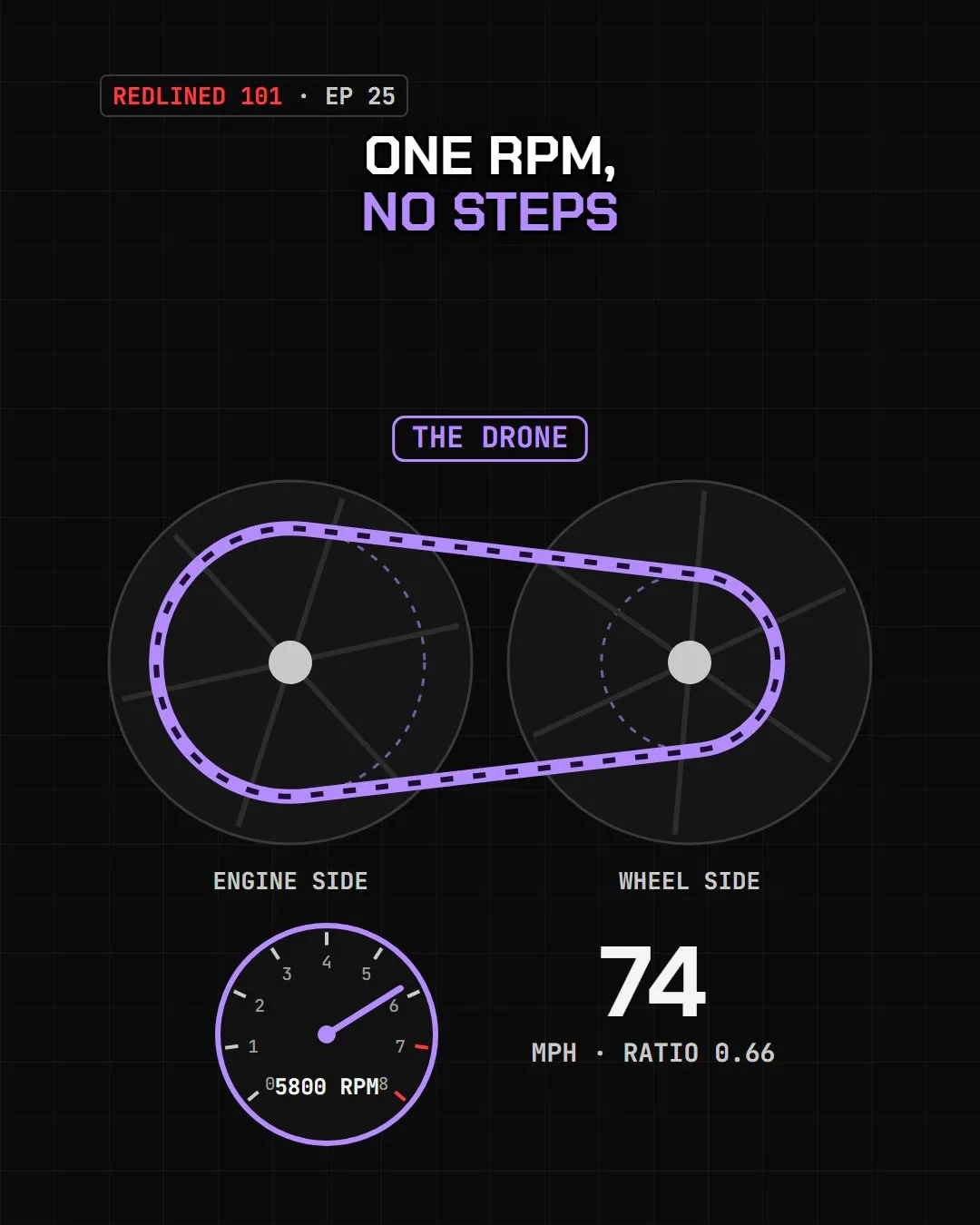
Change the size of the circle on one pulley against the other, and you change the ratio. So the ratio slides with no steps, and the engine just holds one rpm while the car speeds up. On the tach, that's the one needle that never moves.
That's the drone: one steady note while the speed climbs. And that's the rubber band: you press the gas, the revs rise, and the speed catches up afterwards, like stretching a rubber band before it pulls.
#4: The dual-clutch
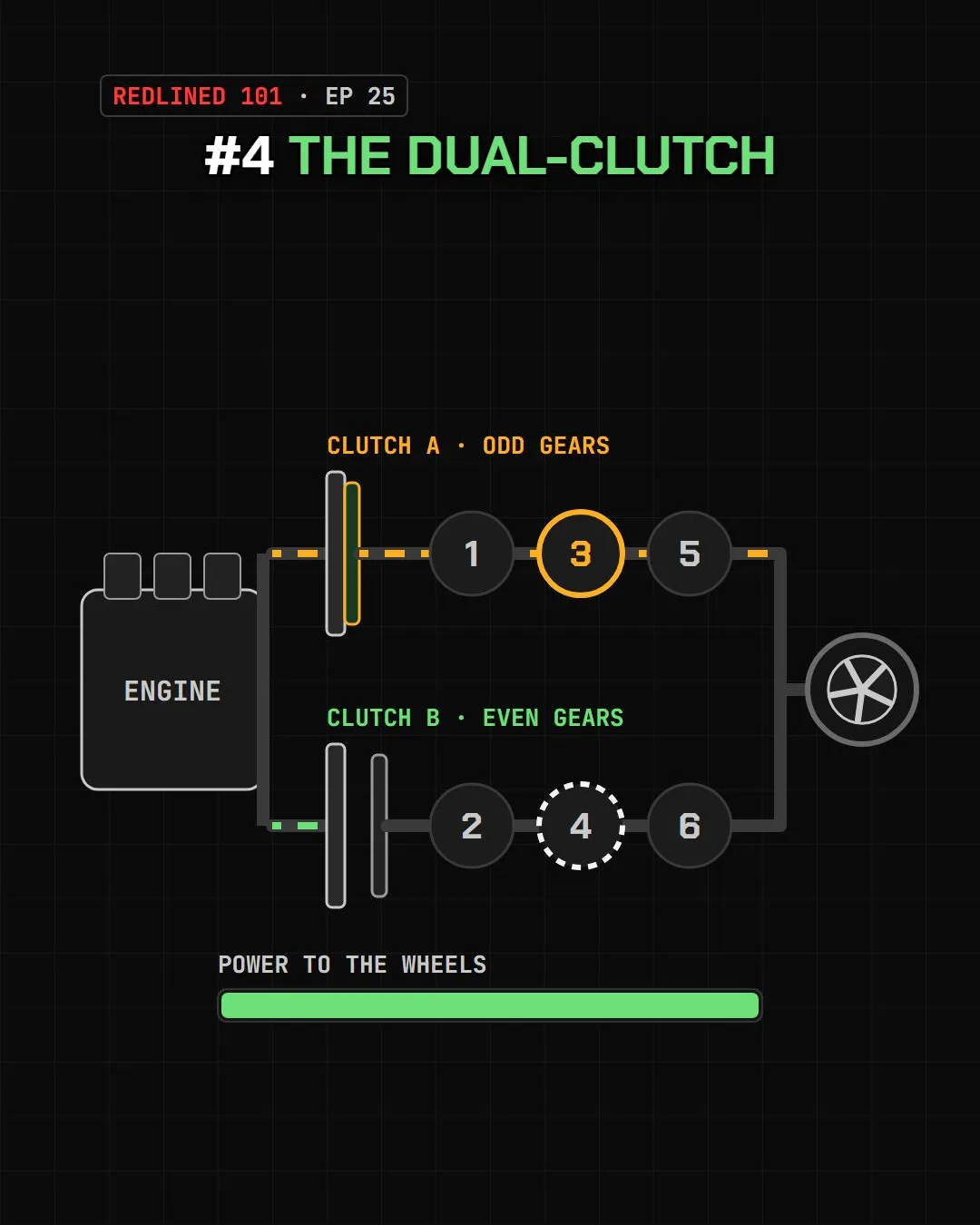
And the dual-clutch is two manuals in one box. One clutch holds the odd gears (1, 3, 5...), the other holds the even ones (2, 4, 6...).
While you're in one gear, the gearbox has already selected the next gear on the other shaft. It's sitting there waiting. So a shift is just one clutch letting go as the other grabs. No pedal, and almost no gap in the power.
The question: which gets to sixty first?
So, same car. Which one gets to sixty first? Most people would put money on the stick.
The answer: not the stick
Not the stick.
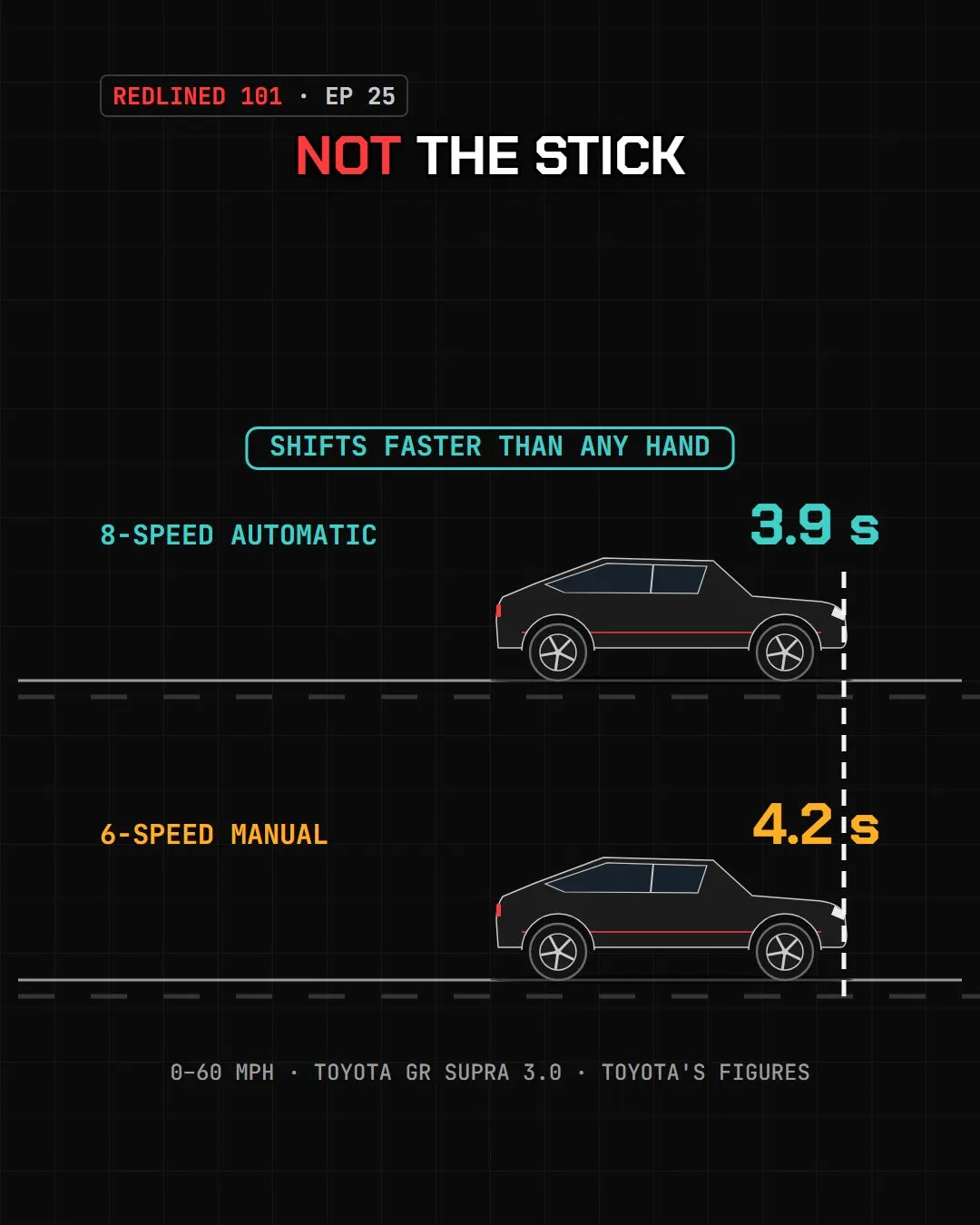
Same Toyota Supra, two gearboxes. With the eight-speed automatic, Toyota says 0 to 60 takes 3.9 seconds. With the manual, 4.2. Those are Toyota's own figures, for the same car.
The reason is the shifts. Modern automatics and dual-clutches shift faster than any hand can. Every manual shift is a gap where the power stops; theirs are overlaps where it barely does.
So the guy who swears his stick is quicker than your automatic? Toyota's own numbers say no. He's still having more fun, though.
The catch with each one
But each one has a catch.
- CVT: the belt grips the pulleys by friction. Too much torque, and it slips. That's why you won't find one behind big power.
- Automatic: it loses a little to that slipping oil in the converter. So at cruise, a lock-up clutch joins the two fans together, and nothing slips.
- Manual: the slowest of the four, but the simplest and the cheapest to fix.
Cheat sheet
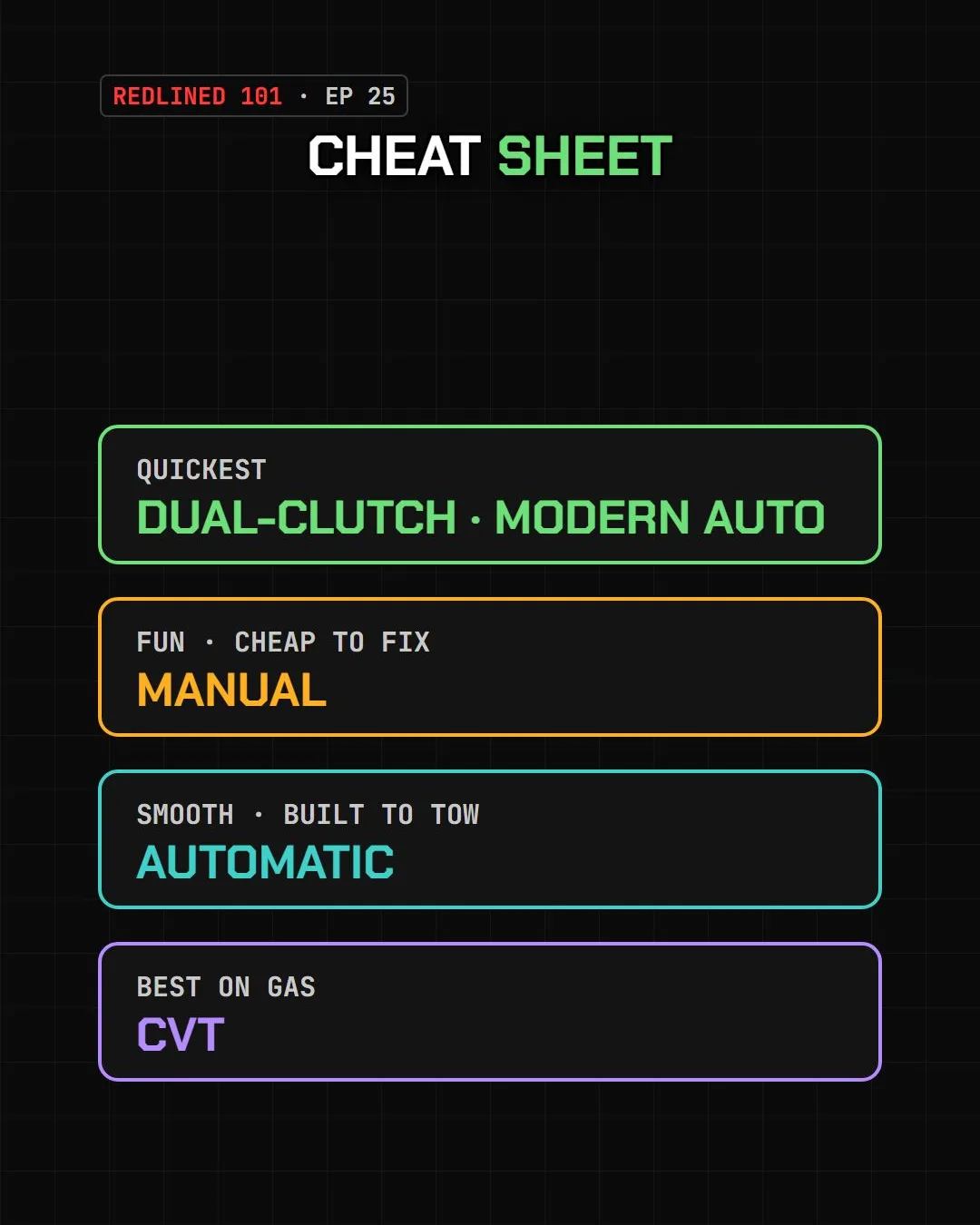
- Quickest: dual-clutch, or a modern automatic.
- Most fun, cheapest to fix: manual.
- Smooth, and built to tow: automatic.
- Best on gas: CVT.
Here's the reasoning behind each line:
- Dual-clutch and modern automatics are quickest because their shifts overlap: one clutch lets go as the next grabs, so there's barely a gap in the power. A manual has a full gap at every shift.
- The manual is the most fun because you're doing the shifting yourself, and cheapest to fix because it's the simplest: a clutch, a shifter and a set of gears.
- The automatic is smooth because the power never fully lets go during a shift, and the converter's slip lets it pull away gently from a stop. That same slip helps it get a heavy load moving, which is why it's the pick for towing.
- The CVT is best on gas because, with no fixed steps, it can keep the engine at whatever rpm it runs most efficiently while the car speeds up. The price is the drone.
Recap
- Manual: you're the gearbox; the power stops at every shift.
- Automatic: a torque converter that slips at a stop and locks at cruise, with planetary gears that shift without fully letting go.
- CVT: two cone pulleys and a belt, no steps, one steady rpm. Not for big power.
- Dual-clutch: two manuals in one box, the next gear already waiting.
- Fastest to sixty in Toyota's Supra figures: the automatic, 3.9 s to the manual's 4.2.
So which one's in yours, and would you swap it?
Next episode: how a bottle of nitrous adds a hundred horsepower.
Frequently asked questions
Is a manual faster than an automatic?
Not any more. Modern automatics and dual-clutches shift faster than any hand. By Toyota's figures, the same Supra does 0 to 60 in 3.9 seconds with the eight-speed automatic and 4.2 with the manual.
What is the difference between a CVT and an automatic?
A conventional automatic has fixed gears, in planetary sets, and shifts between them. A CVT has no gears: a belt runs between two pulleys made of cones, and moving the cones slides the ratio with no steps.
Why does a CVT drone?
Because the ratio slides instead of stepping, the engine holds one rpm while the car speeds up. You hear a steady note that doesn't rise and fall with the speed, which is the drone people call the rubber-band feel.
Why aren't CVTs used in high-horsepower cars?
The belt grips the pulleys by friction, so too much torque makes it slip. That is why you won't find one behind big power.
How does an automatic not stall at a red light?
Its torque converter works like two fans facing each other, with oil instead of air. At a stop, the oil just slips between them; step on the gas and it grabs. At cruise, a lock-up clutch joins the two halves so nothing slips.
Is a dual-clutch the same as an automatic?
It drives like one, with no clutch pedal, but inside it is two manuals in one box: one clutch for the odd gears and one for the even, so the next gear is already waiting.
Official merch
Shop the club merch
3 Pedals 0 F*cks Manual Transmission on a Unisex Oversized Heavyweight T-Shirt, black
Unisex Oversized Heavyweight T-Shirt
from $38.49
Pork Roll, Egg, Cheese & Boost – Jersey Breakfast on a Unisex Oversized Heavyweight T-Shirt, black
Unisex Oversized Heavyweight T-Shirt
from $32.99
My Toxic Trait: One More Project Car on a Unisex Oversized Heavyweight T-Shirt, black
Unisex Oversized Heavyweight T-Shirt
from $32.99
+1000 Aura – Exhaust Flames Car Shirt on a Unisex Oversized Heavyweight T-Shirt, white
Unisex Oversized Heavyweight T-Shirt
from $32.99
Unc Can Still Heel-Toe – Manual Driver Shirt on a Unisex Oversized Heavyweight T-Shirt, black
Unisex Oversized Heavyweight T-Shirt
from $32.99
But Officer The Sign Said Slide It on a Unisex Oversized Heavyweight T-Shirt, white
Unisex Oversized Heavyweight T-Shirt
from $32.99
Redlined Car Club Est. 2023 Brushmark on a Unisex Oversized Heavyweight T-Shirt, black
Unisex Oversized Heavyweight T-Shirt
from $32.99
Car Guy By Definition on a Unisex Oversized Heavyweight T-Shirt, black
Unisex Oversized Heavyweight T-Shirt
from $32.99
Tokyo Retro Vibes on a Unisex Oversized Heavyweight T-Shirt, black
Unisex Oversized Heavyweight T-Shirt
from $32.99
BOSOZOKU CARSPANK ボ — ソ — 族 — 車 の ス パ ン ク on a Unisex Oversized Heavyweight T-Shirt, black
Unisex Oversized Heavyweight T-Shirt
from $32.99
Coilovers > 401K – Funny Car Guy on a Unisex Oversized Heavyweight T-Shirt, black
Unisex Oversized Heavyweight T-Shirt
from $32.99
Can't Pump Gas, Can Swap A Motor – NJ Car Guy on a Unisex Oversized Heavyweight T-Shirt, black
Unisex Oversized Heavyweight T-Shirt
from $32.99




More from the club
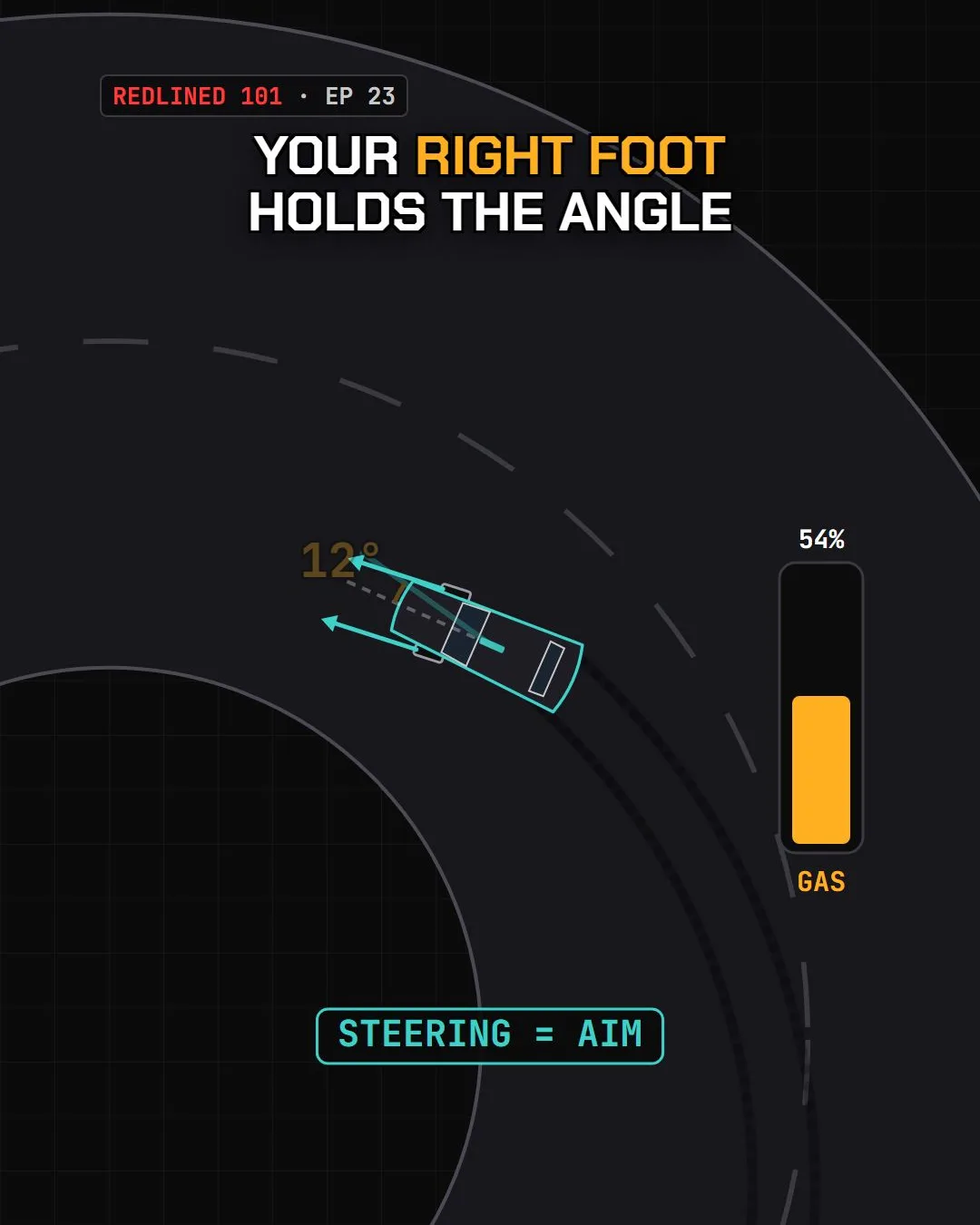
How Drifting Works: Throttle, Steering, Handbrake and Clutch Kick (Redlined 101, Ep 23)
Why a sliding tire wants to stay loose, why lifting off the gas snaps the car the other way, how the throttle holds the drift angle, clutch kick vs handbrake, and why steering lock and angle kits set the limit.
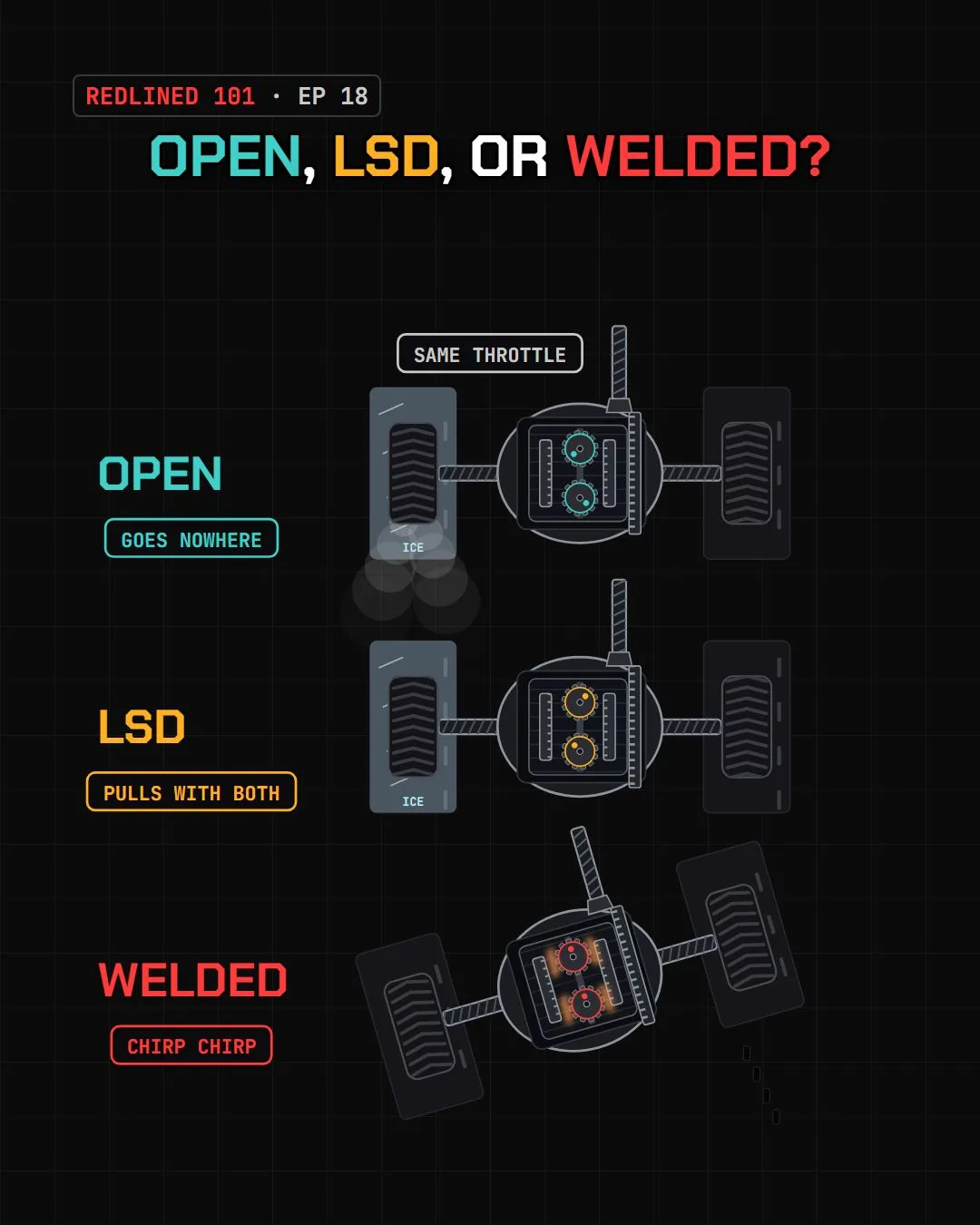
Open Diff vs Limited-Slip vs Welded Diff: What's the Difference? (Redlined 101, Ep 18)
How an open differential splits torque and why one tire on ice stops you, clutch-type vs gear-type (Torsen) limited-slip and the one-wheel-in-the-air test, and why a welded diff drifts well but chirps in every parking lot.
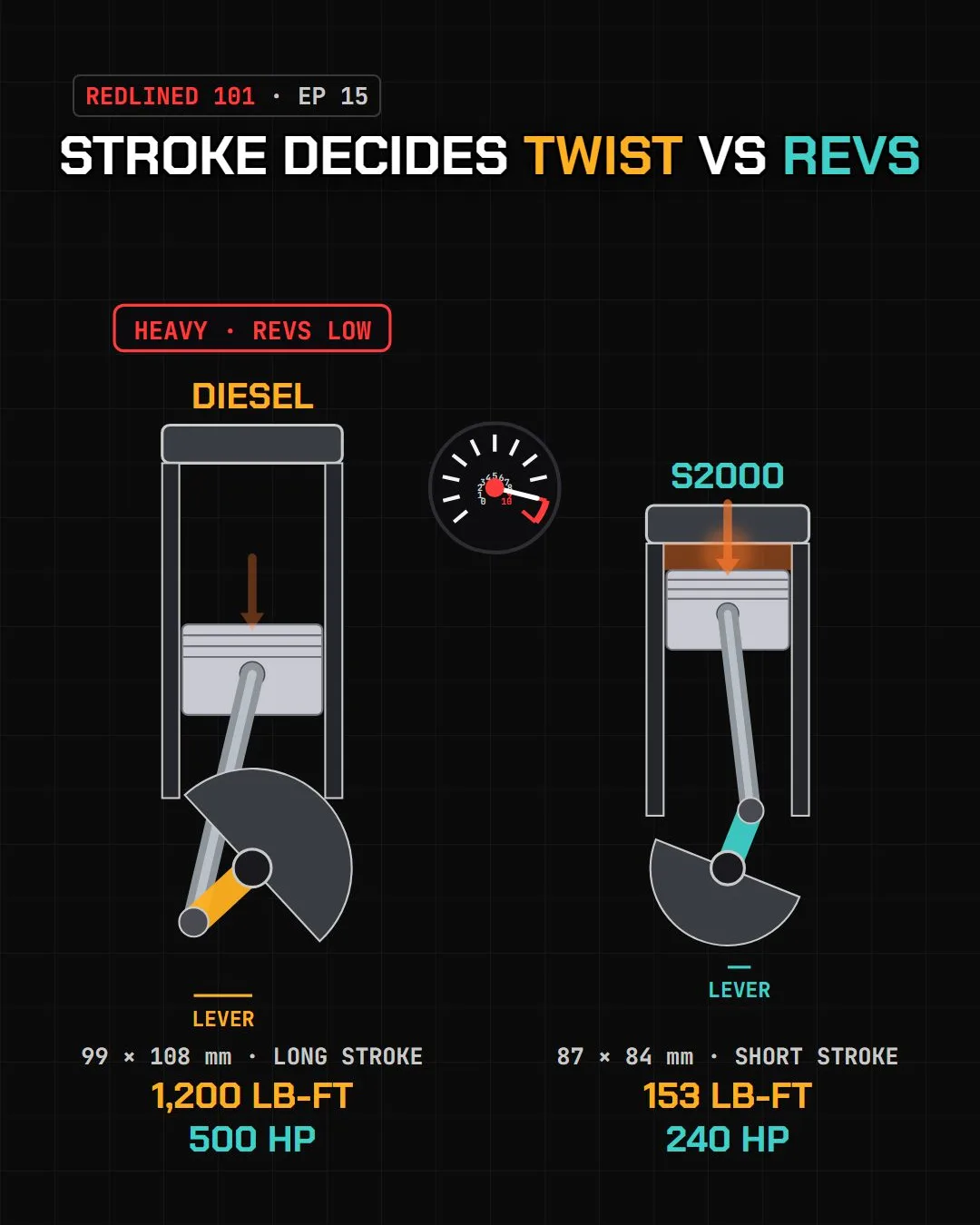
Horsepower vs Torque: What's the Difference and Which Matters More? (Redlined 101, Ep 15)
What torque and horsepower actually are, how the gearbox multiplies torque, why the two curves cross at 5,252 rpm, why a 1,200 lb-ft truck loses to a 240 hp S2000, and why torque is still what you feel.