
Muffler Delete vs Resonator Delete vs Straight Pipe: Which One Drones? (Redlined 101, Ep 22)
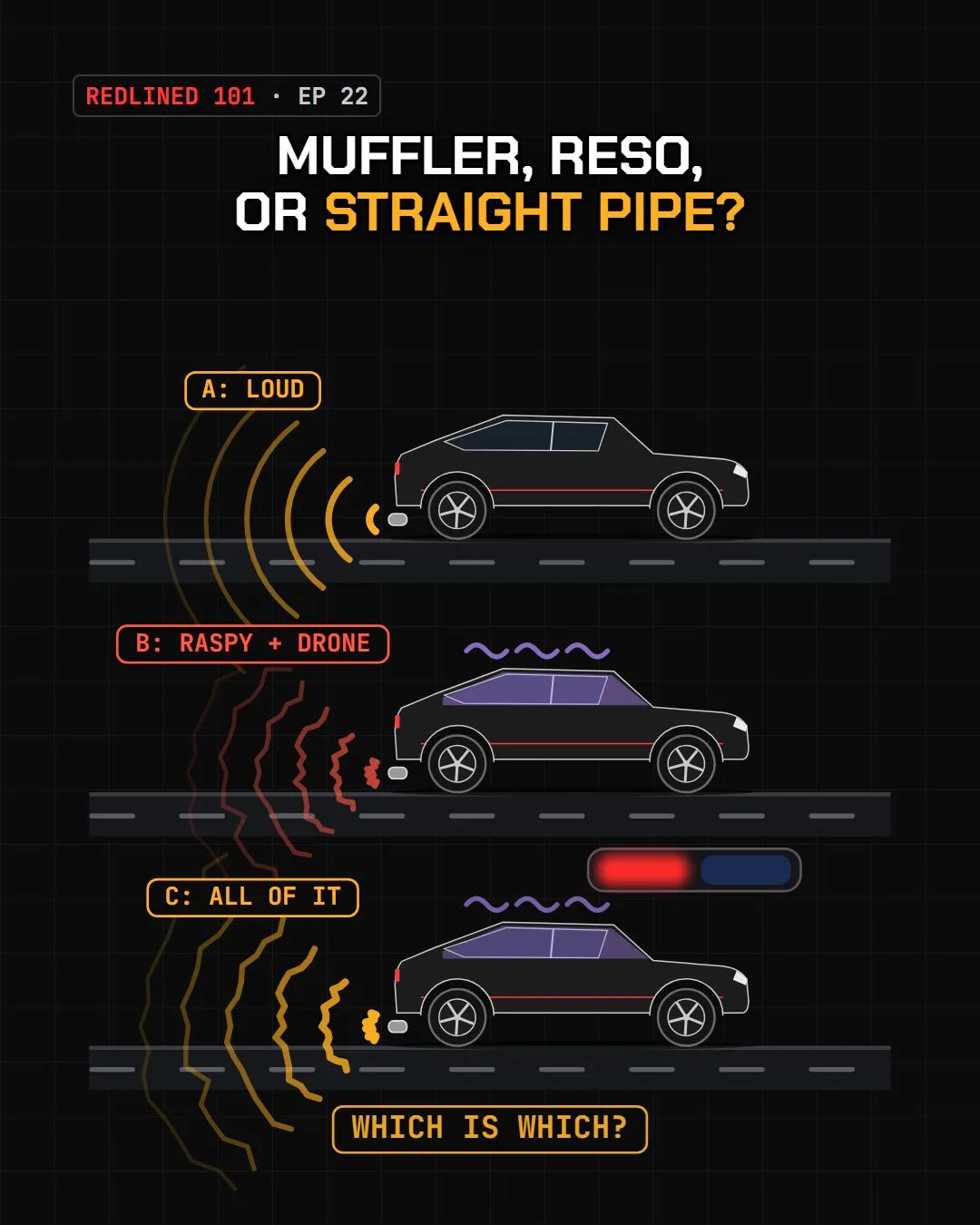
Muffler delete, resonator delete, or straight pipe? Same car, same highway. One just gets loud. One gets raspy, and drones till you hate your own car. And one gets you all of it, plus a ticket. Here's which is which, and the physics of why, without needing a degree in acoustics.
Watch Redlined 101, Ep 22 on Instagram →
The layout: what's under there
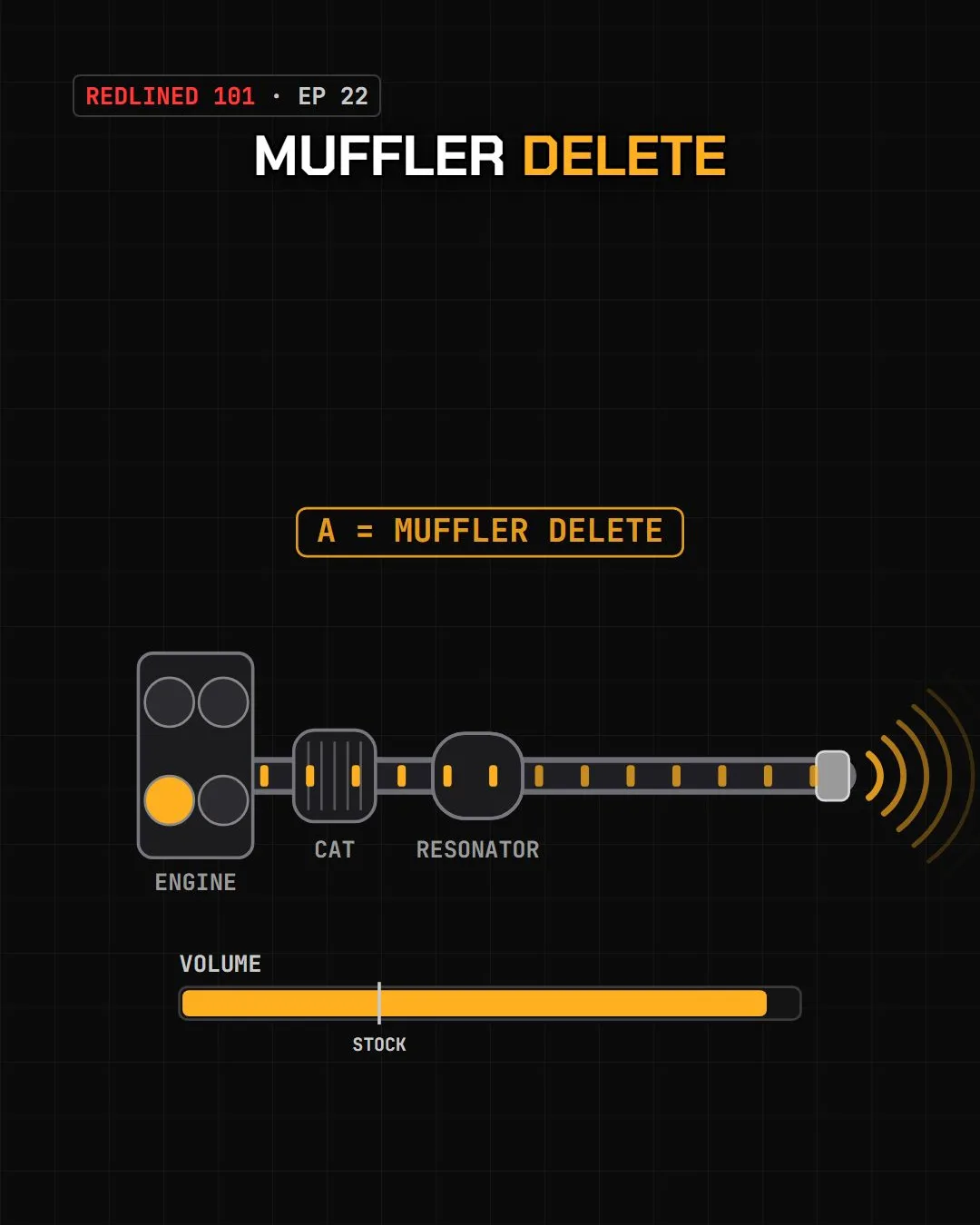
Follow the exhaust from the engine back. The gases leave the engine, pass through the catalytic converter (the cat, which cleans up the emissions), then usually a small can called the resonator, then the muffler, the big can at the back, and out the tip. A "cat-back" exhaust replaces everything from the cat to the tip. A delete pulls out one of those cans and puts plain pipe in its place.
Muffler delete: the loud one
Start with the big can at the back. Your engine doesn't hum, it claps. Every time a cylinder fires and its exhaust valve opens, a slug of hot gas bursts into the pipe. The muffler swallows those claps, like yelling into a pillow. Inside, chambers bounce the pulses around so they cancel each other, and sound-deadening packing soaks up what's left.
Delete it, and every clap gets out. That's the loud one.
The question: big can or little can?
So that highway drone, the hum that makes you turn the music up: which delete causes it? The big muffler, or the little resonator? Most people say the muffler, because it's the big one. It isn't.
Where drone comes from
Here's the physics, step by step.
Every clap is a pressure pulse. It races down the hot pipe at around a thousand miles an hour, which is the speed of sound in hot exhaust gas.
The pulses come at a steady beat. A four-cylinder fires twice every turn of the crank. Cruising at 2,500 rpm, that's 2,500 × 2 ÷ 60 = 83 pulses every second.
A steady beat is a note. 83 pulses a second is an 83 hertz note, a low hum. Along with it come fainter copies of the note at double, triple and four times the frequency: about 167, 250 and 333 Hz.
- The low note is the drone.
- The copies are the rasp.
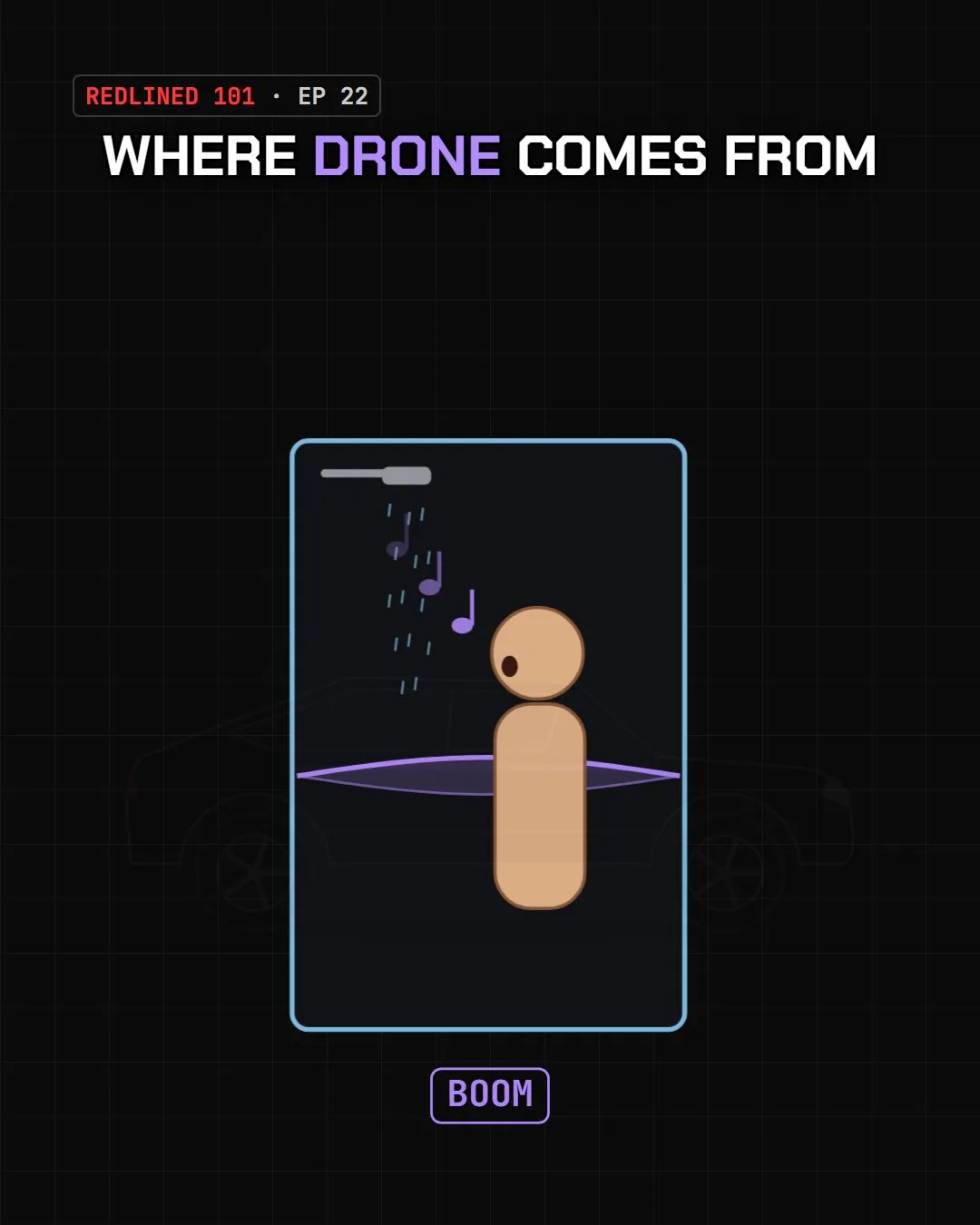
Your cabin has notes it likes. Hum in the shower and you'll find the note the room likes: hit it, and the whole room booms. That's resonance. Your car's cabin is a box with notes it likes too. When the exhaust's cruise note lands on one, the cabin booms along with it, and that's the drone you feel in your chest on the highway.
The answer: it's the little resonator
The two cans do different jobs.
The muffler is a blunt tool. In the episode's example, the pipe opens into a can with nine times the area. When a pulse hits that sudden change, about 80 percent of it bounces back up the pipe, and only about 20 percent carries on. It knocks down every pulse, at every rpm. That's volume control, not note control.
The resonator is a sniper. It works like noise-cancelling headphones: it sends back a mirror-image wave that cancels the sound it's aimed at.
The simplest kind is a dead-end tube branching off the pipe, a quarter of a wavelength long. The pulse runs into the tube, bounces off the closed end, and comes back out having traveled half a wavelength in total. So it arrives half a cycle late, which means flipped: its high pressure lands on the incoming wave's low pressure, and the two cancel. For an 83 Hz note, that's a tube about three to four feet long. (The exact length depends on how hot the gas in the tube is, since sound travels faster in hotter gas.)
Pull the resonator, and that note comes right back, along with the rasp. That's the raspy one, and the one that drones.
Straight pipe: all of it, plus a ticket
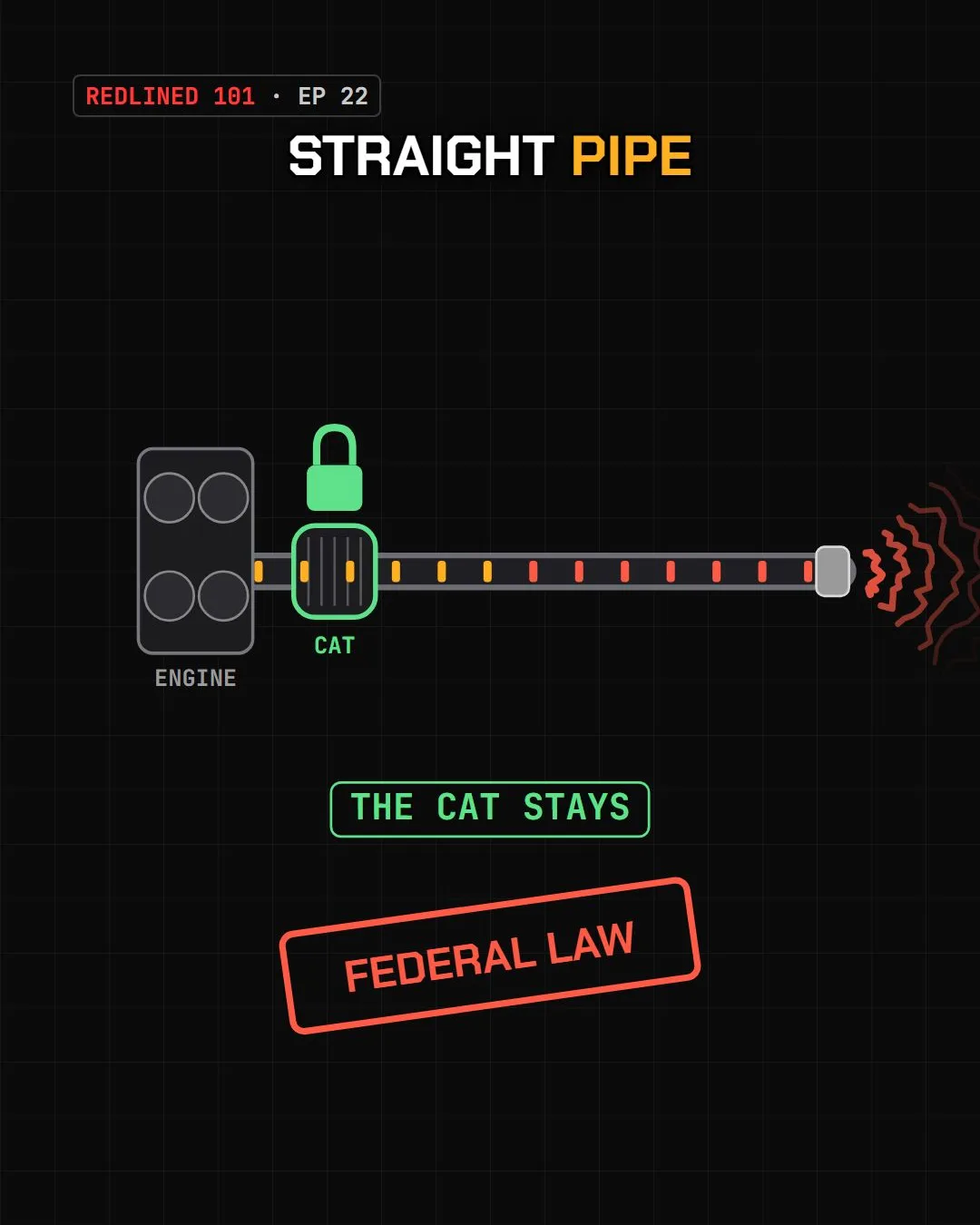
A straight pipe pulls both cans. You get loud, raspy, and the drone.
It also gets you pulled over. In New Jersey, the law says every car needs a working muffler, so a straight pipe is a ticket waiting to happen.
And whatever you do to the rest of the system, the cat stays. Always. Pulling the catalytic converter is a federal no: it's emissions tampering under federal law, not just a state fine.
So you know that friend who straight-piped his Civic, and now he wears earplugs on the highway? Now you know why: no resonator, so nothing is cancelling that cruise note.
The move: loud and clean
Here's how to do it right.
Want it louder, with less drone? Swap the stock muffler for a straight-through muffler, and keep the resonator. A straight-through muffler runs a perforated pipe straight through the can, wrapped in packing, so it's louder than a chambered stock muffler. The resonator stays to keep killing the cruise note. And the cat stays too.
Already droning? Work out your drone note:
Drone note (Hz) = rpm × cylinders ÷ 120
Use the rpm where the drone is worst. Each cylinder fires once every two turns of the crank, which is where the 120 comes from (60 seconds × 2 turns). A few examples:
- Four-cylinder at 2,500 rpm: 2,500 × 4 ÷ 120 = 83 Hz.
- V8 at 2,000 rpm: 2,000 × 8 ÷ 120 = 133 Hz.
Then tune a J-pipe to it. A J-pipe is that quarter-wave dead-end tube from earlier, usually bent into a J so it fits under the car. A higher note needs a shorter tube; a lower note, a longer one.
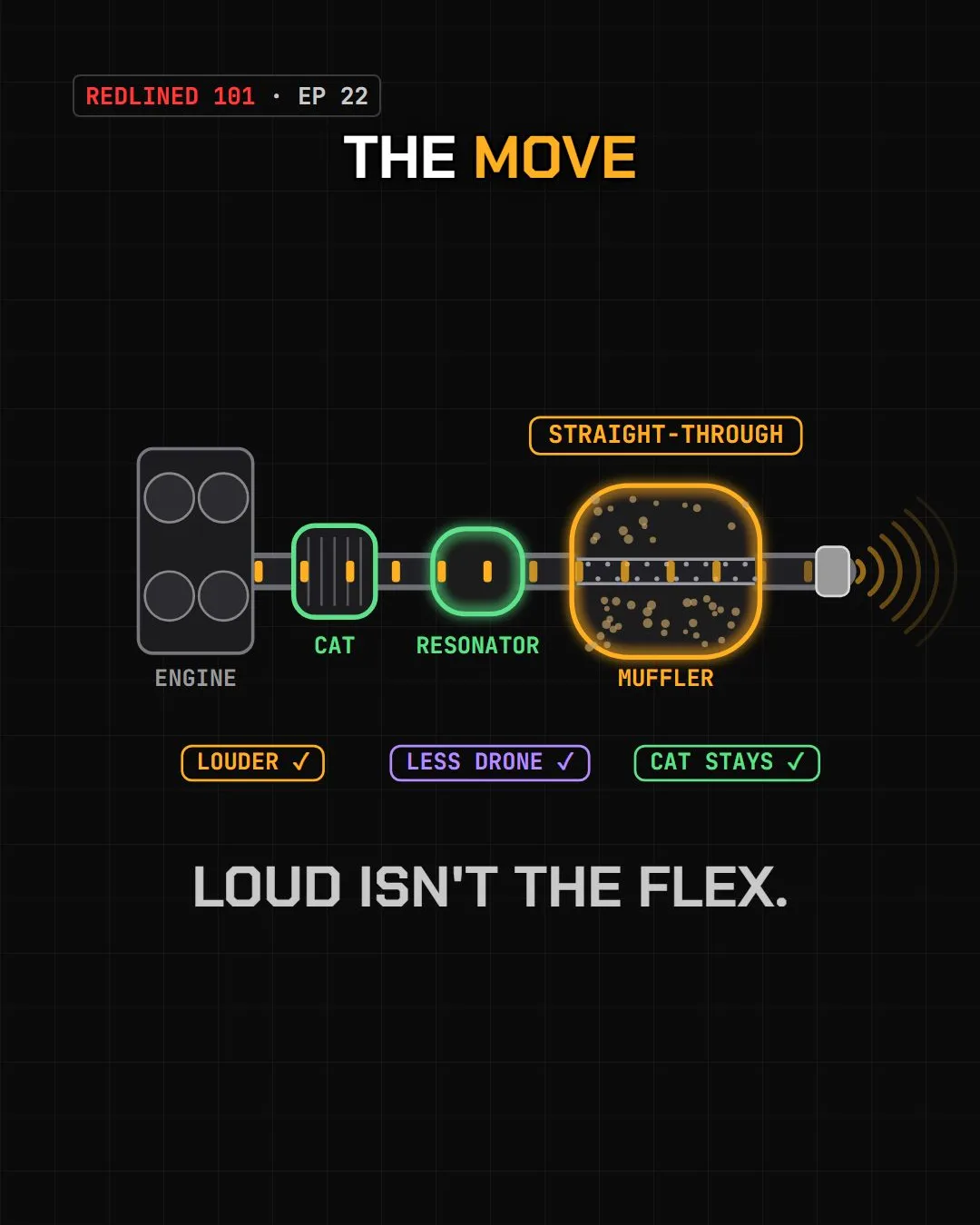
Loud isn't the flex. Loud and clean is.
If you're curious about the other noises tuned cars make, the pops, bangs and flutters, Ep 20 and Ep 13 cover those.
Recap
- Muffler delete: loud. The muffler was swallowing every clap.
- Resonator delete: raspy, with drone. The resonator was cancelling the cruise note.
- Straight pipe: loud, raspy and droning, and in New Jersey, a ticket.
- Drone note: rpm × cylinders ÷ 120. A tuned J-pipe cancels it.
- The cat stays, always.
So what's on yours: stock, cat-back, or straight pipe?
Next episode: how drifting works.
Frequently asked questions
Does a muffler delete or a resonator delete cause drone?
The resonator delete. The muffler mostly controls overall loudness, while the resonator is tuned to cancel the low note that fills the cabin at highway cruise. Pull it, and the drone and the rasp come back.
What is the difference between a muffler and a resonator?
A muffler is a blunt tool that knocks down every pulse: its chambers bounce much of each pulse back and its packing soaks up the rest. A resonator is tuned to one note and cancels it by sending back a mirror-image wave, like noise-cancelling headphones.
Is a straight pipe legal in New Jersey?
No. New Jersey law says every car needs a working muffler, so a straight pipe is a ticket waiting to happen. The catalytic converter has to stay on any car regardless; removing it is against federal law.
How do I get rid of exhaust drone?
Work out your drone note: rpm times cylinders, divided by 120, at the rpm where it drones. Then fit a J-pipe, a dead-end side tube a quarter of a wavelength long, tuned to that note.
How do I make my exhaust louder without drone?
Swap the stock muffler for a straight-through muffler and keep the resonator. You get more volume while the resonator keeps cancelling the cruise note. The cat stays either way.
Official merch
Shop the club merch
3 Pedals 0 F*cks Manual Transmission on a Unisex Oversized Heavyweight T-Shirt, black
Unisex Oversized Heavyweight T-Shirt
from $38.49
Pork Roll, Egg, Cheese & Boost – Jersey Breakfast on a Unisex Oversized Heavyweight T-Shirt, black
Unisex Oversized Heavyweight T-Shirt
from $32.99
My Toxic Trait: One More Project Car on a Unisex Oversized Heavyweight T-Shirt, black
Unisex Oversized Heavyweight T-Shirt
from $32.99
+1000 Aura – Exhaust Flames Car Shirt on a Unisex Oversized Heavyweight T-Shirt, white
Unisex Oversized Heavyweight T-Shirt
from $32.99
Unc Can Still Heel-Toe – Manual Driver Shirt on a Unisex Oversized Heavyweight T-Shirt, black
Unisex Oversized Heavyweight T-Shirt
from $32.99
But Officer The Sign Said Slide It on a Unisex Oversized Heavyweight T-Shirt, white
Unisex Oversized Heavyweight T-Shirt
from $32.99
Redlined Car Club Est. 2023 Brushmark on a Unisex Oversized Heavyweight T-Shirt, black
Unisex Oversized Heavyweight T-Shirt
from $32.99
Car Guy By Definition on a Unisex Oversized Heavyweight T-Shirt, black
Unisex Oversized Heavyweight T-Shirt
from $32.99
Tokyo Retro Vibes on a Unisex Oversized Heavyweight T-Shirt, black
Unisex Oversized Heavyweight T-Shirt
from $32.99
BOSOZOKU CARSPANK ボ — ソ — 族 — 車 の ス パ ン ク on a Unisex Oversized Heavyweight T-Shirt, black
Unisex Oversized Heavyweight T-Shirt
from $32.99
Coilovers > 401K – Funny Car Guy on a Unisex Oversized Heavyweight T-Shirt, black
Unisex Oversized Heavyweight T-Shirt
from $32.99
Can't Pump Gas, Can Swap A Motor – NJ Car Guy on a Unisex Oversized Heavyweight T-Shirt, black
Unisex Oversized Heavyweight T-Shirt
from $32.99






More from the club
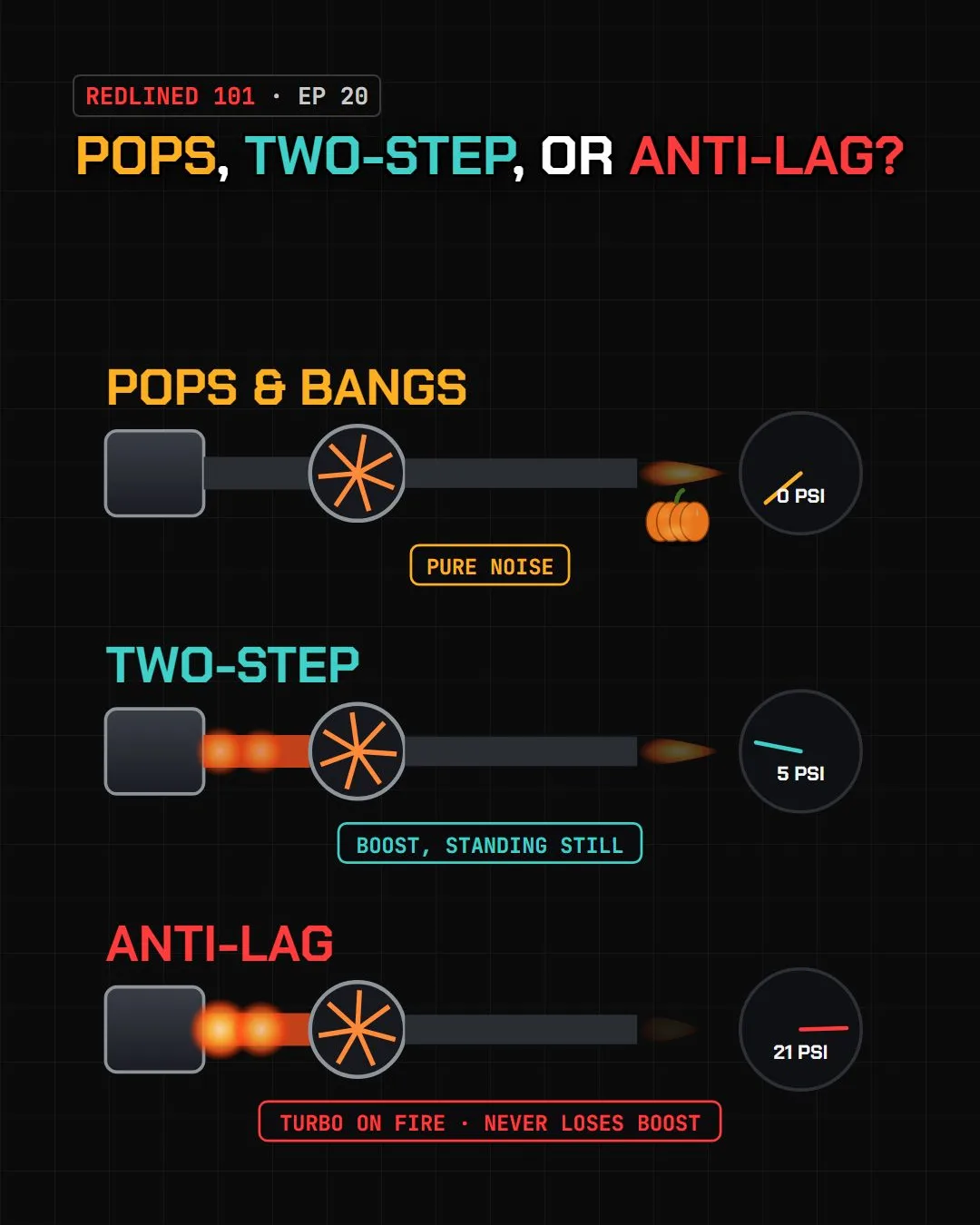
Anti-Lag vs Two-Step vs Pops and Bangs: What's the Difference? (Redlined 101, Ep 20)
Why a pops-and-bangs tune is pure noise with zero boost, how a two-step launch limiter builds boost standing still, how real rally anti-lag keeps the turbo spinning off the gas, and what all that fire costs.
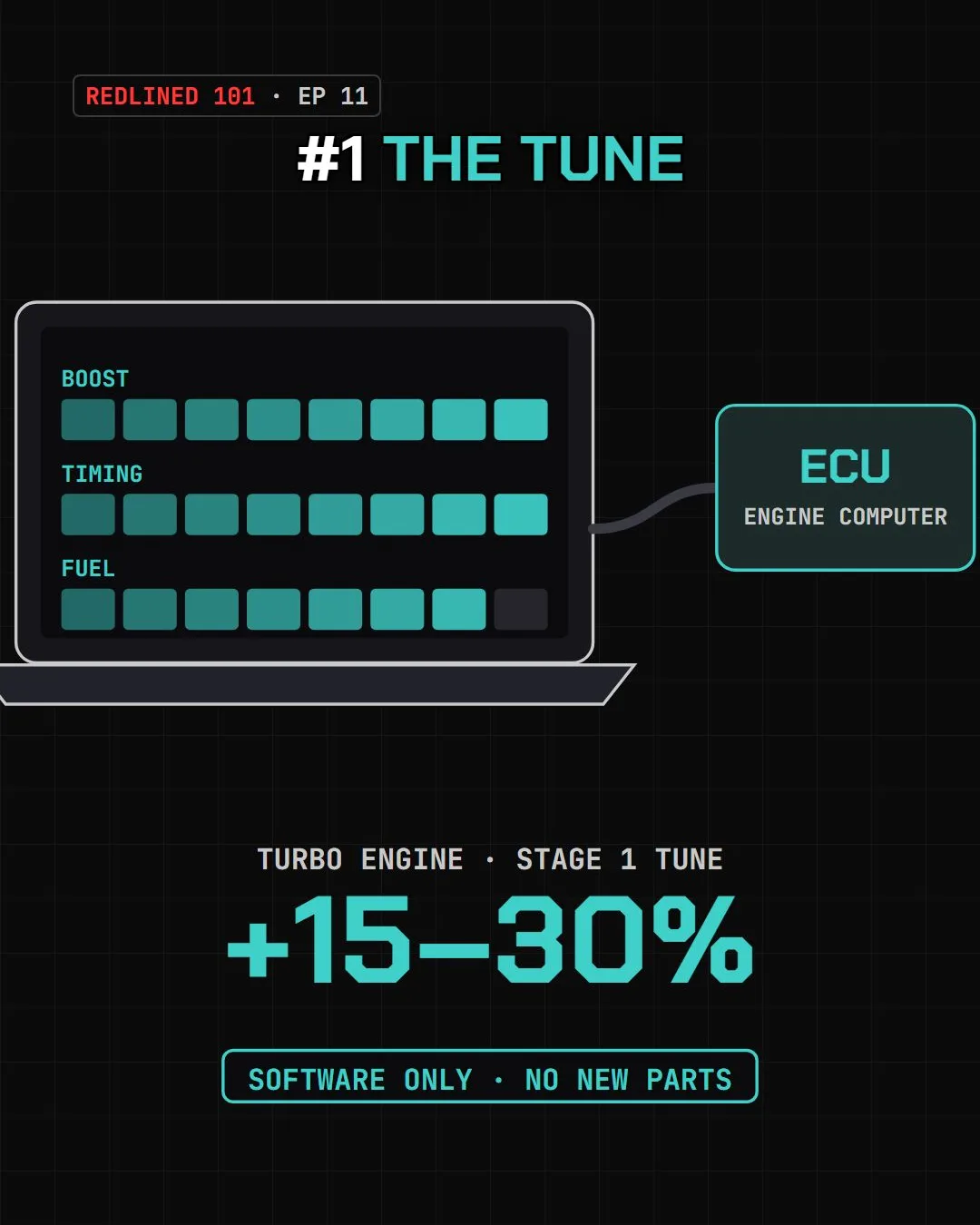
Intake vs Exhaust vs Tune: Which Car Mods Actually Add Horsepower? (Redlined 101, Ep 11)
What a cold air intake, a cat-back exhaust and an ECU tune really do on the dyno, why builds go in stages, how tires and weight make a car faster for free, and the catch that comes with more power.
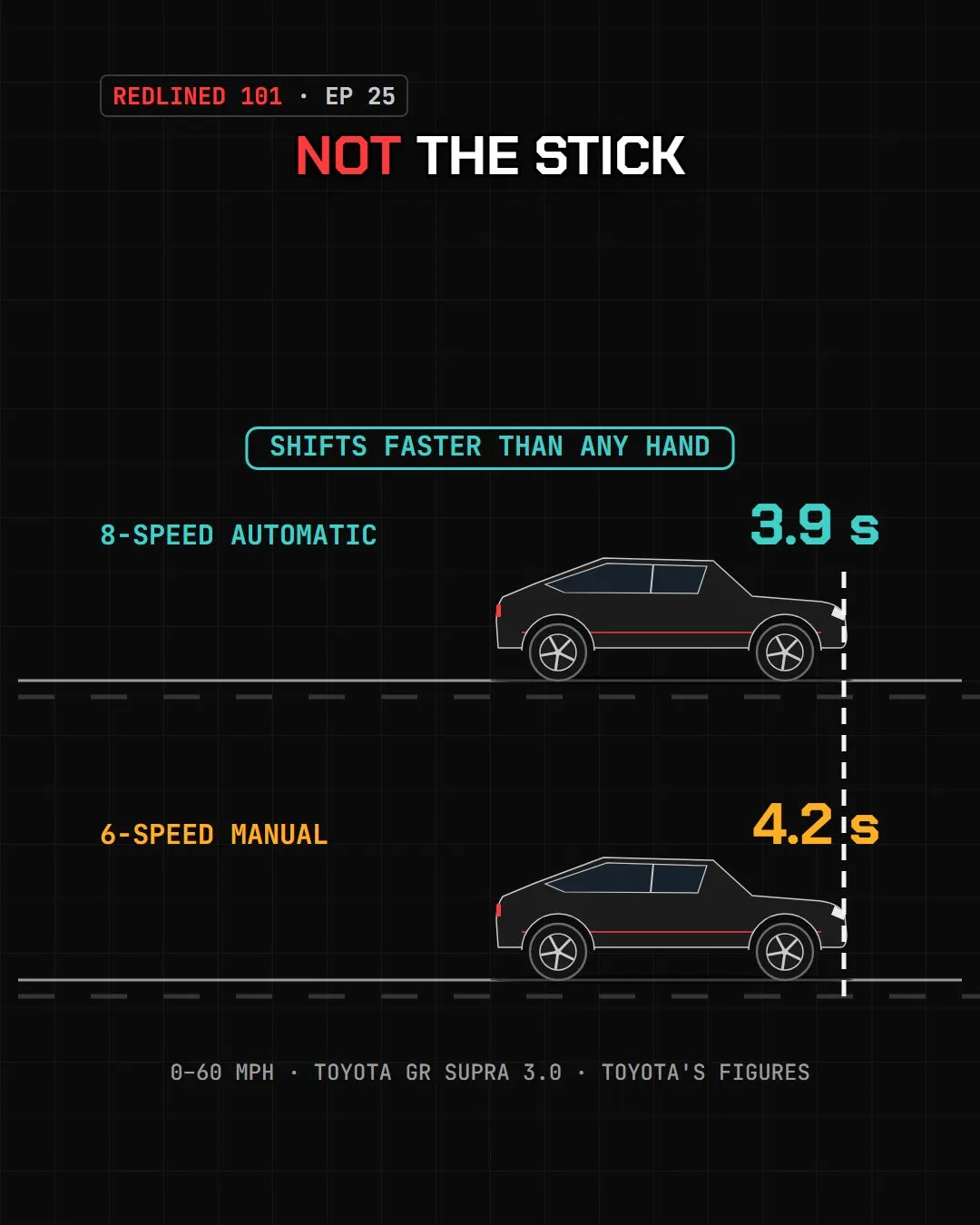
Manual vs Automatic vs CVT vs Dual-Clutch: Which Is Fastest? (Redlined 101, Ep 25)
How a manual, a torque-converter automatic, a CVT and a dual-clutch each work, which one gets to 60 first (Toyota's Supra figures), the catch with each, and which to pick for speed, fun, towing or fuel.