Small Turbo vs Big Turbo vs Twin Turbo: Lag, Spool and Sequential Twins (Redlined 101, Ep 17)
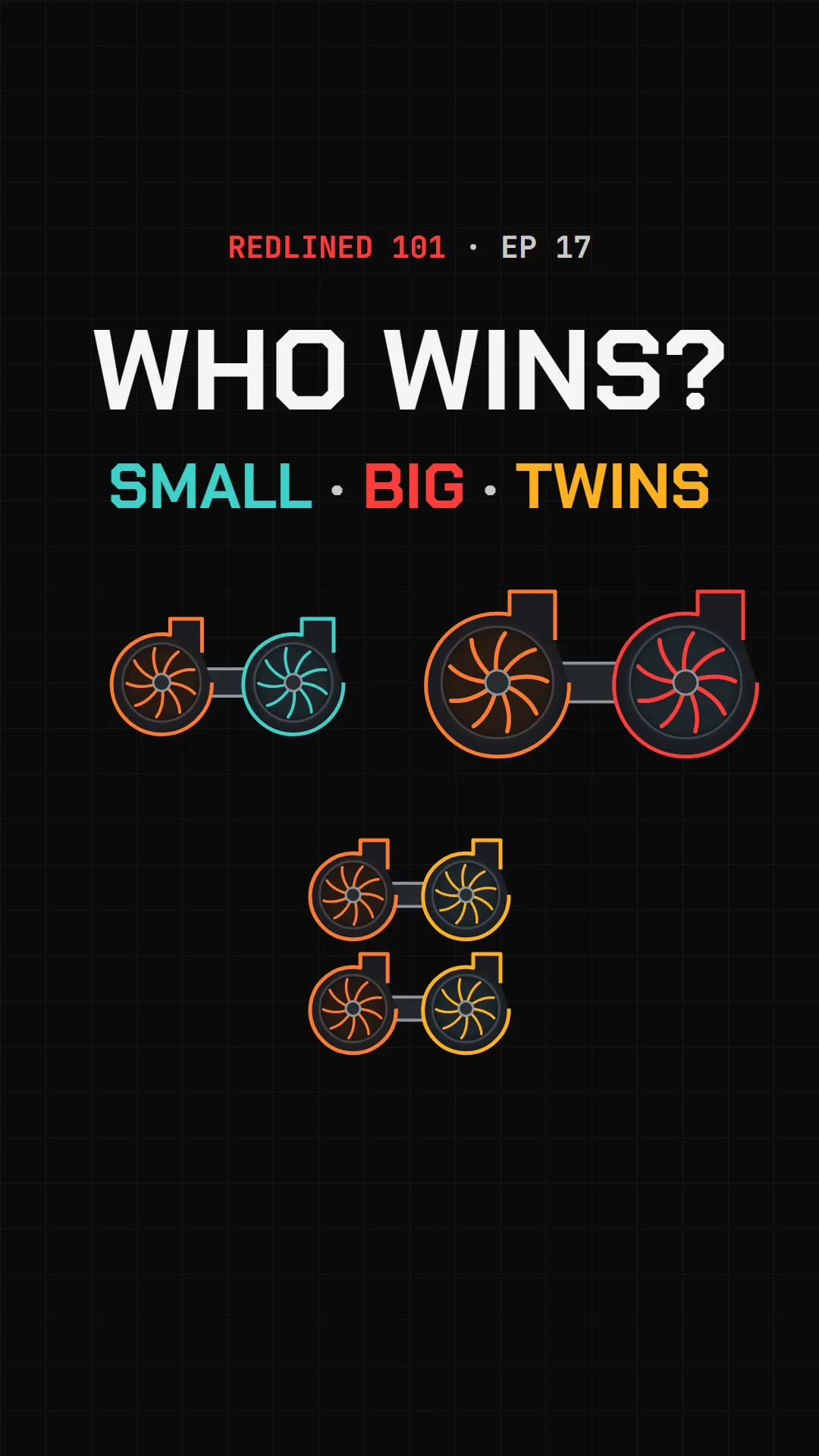
Small turbo, big turbo, or twins? Bolt each one to the same engine and you get three different cars. One hits instantly. One hits late, like a truck. And one cheats to get both. Last episode ended on Toyota's 2JZ inline-six; this one puts two turbos on it.
 Watch on Instagram
A turbo in thirty seconds
A turbo is two fans on one shaft. Exhaust gas leaving the engine spins the turbine wheel. The turbine turns the compressor wheel on the other end, which crams extra air into the engine. More air means more fuel can burn, and more fuel burned means more power. That pressure above atmospheric is boost, and getting the turbo up to speed is called spooling. (For how that compares with a belt-driven supercharger, see turbo vs supercharger.)
Because it runs on exhaust, a turbo is always waiting on the engine. Little exhaust at low revs, a flood at high revs. The size of the wheels decides how it handles both ends.
The small turbo: instant, then out of breath
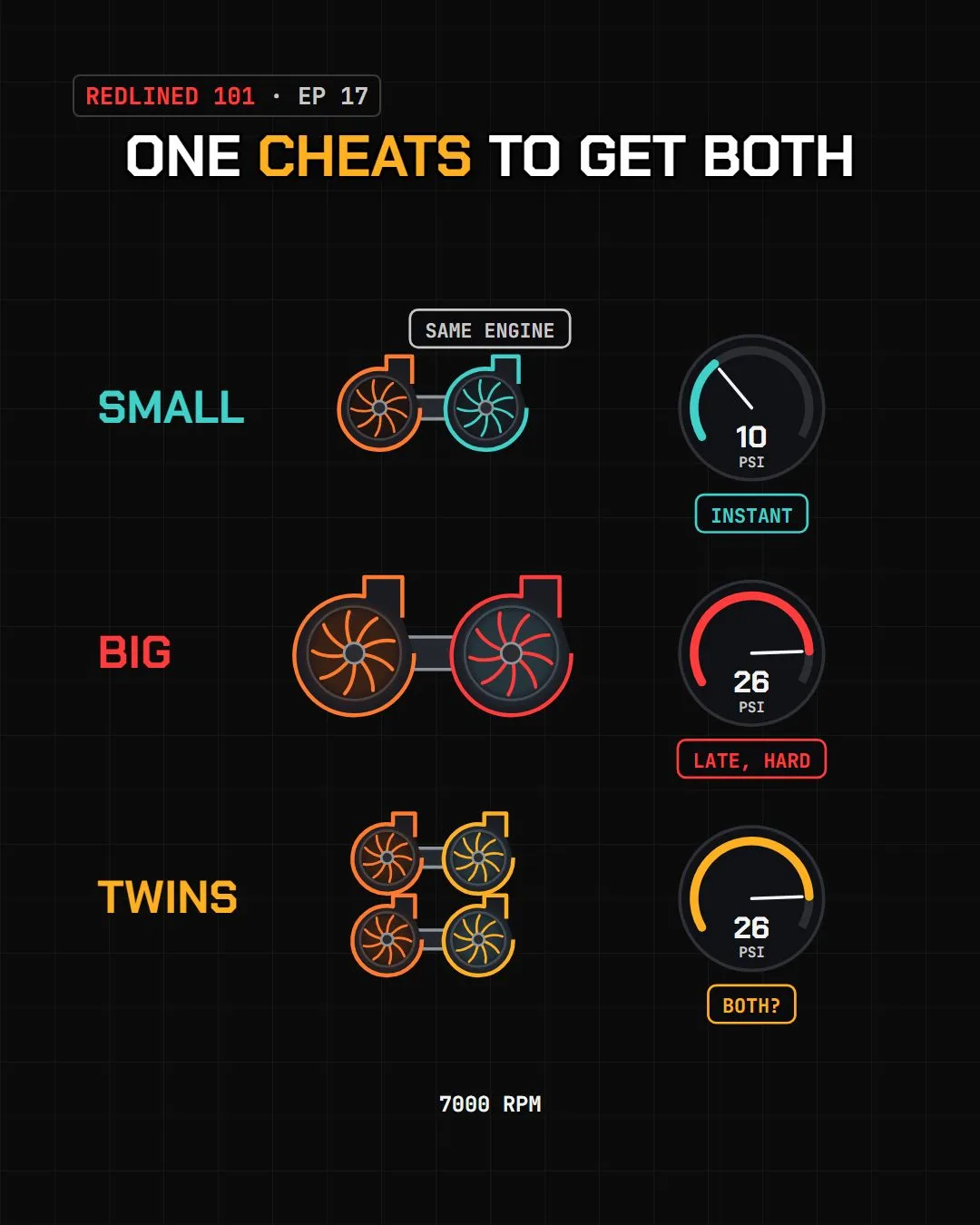
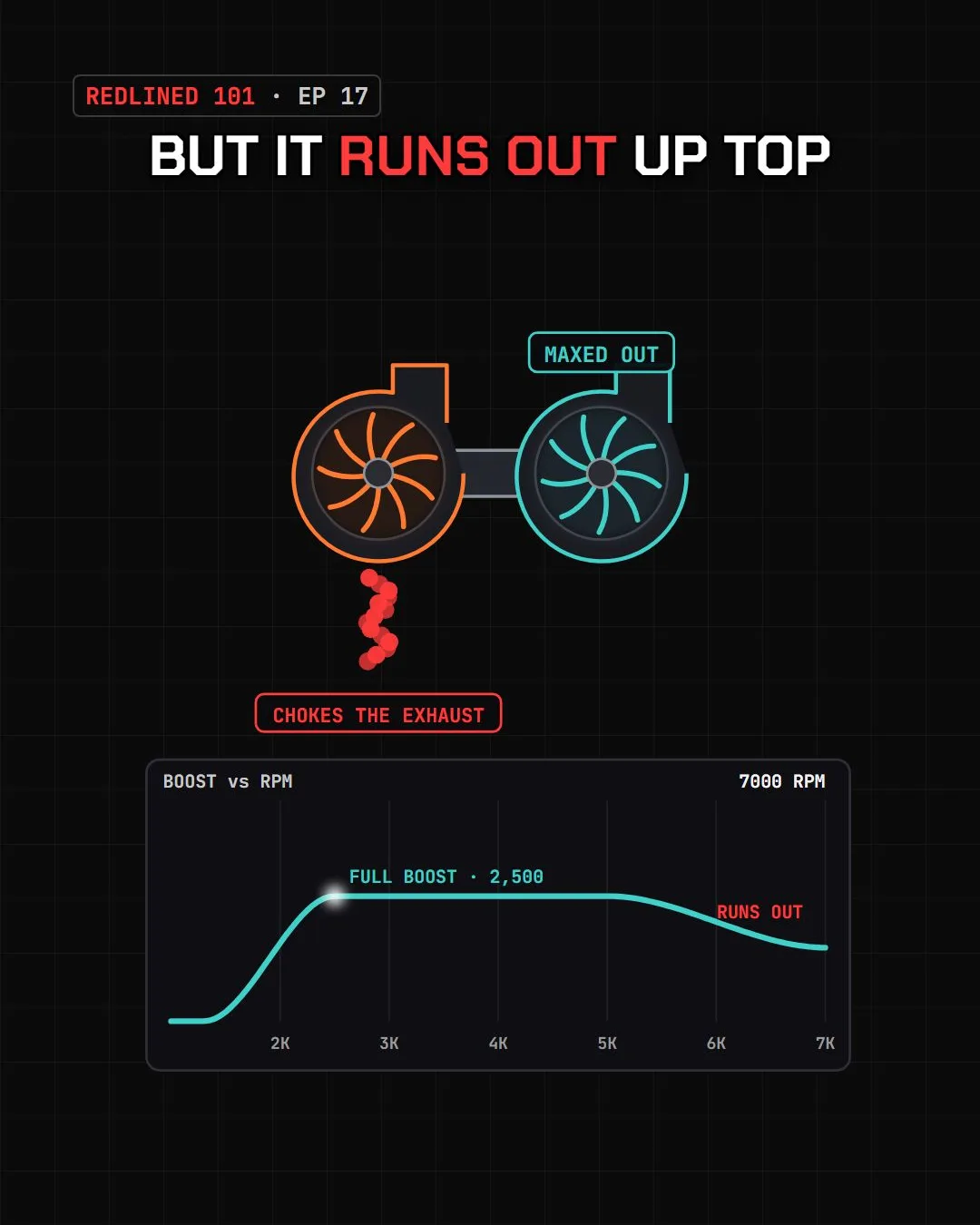
The instant one is the small turbo. It has light wheels, so a little exhaust is enough to spin it up. It's at full boost by about 2,500 rpm, right where you drive around town.
But up top, it runs out of breath. Two things go wrong at once:
- The tiny compressor wheel can't move any more air. It's maxed out. Spin the engine faster and it wants more air than the turbo can supply.
- It chokes the exhaust that's driving it. The small turbine is a narrow doorway for a lot of exhaust gas. Pressure builds up in front of it, the engine has to push its exhaust out harder, and power fades near redline.
Great on the street, flat on the dyno.
The question: one big turbo, or two?
So off the line, who boosts first: one big turbo, or two?
The big turbo: late, then hardest of all
Two, if they're set up right. Here's why the big single loses that one.
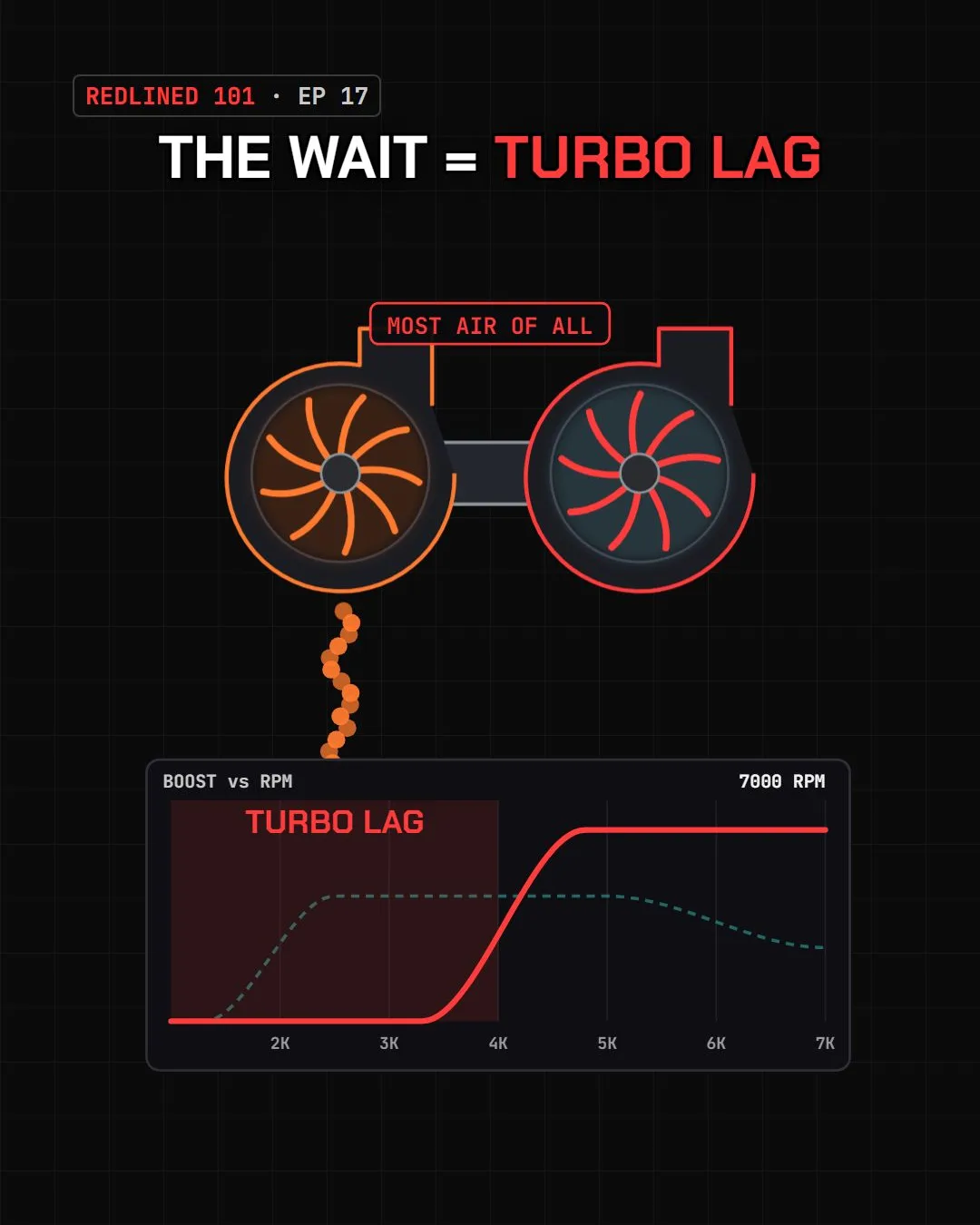
A big turbo has heavy wheels. It needs a flood of exhaust before it wakes up, and at low revs the engine just isn't making that much. So the big turbo makes almost nothing until about 4,000 rpm. You press the pedal and wait.
That delay is turbo lag. Below the point where the turbo comes alive, the engine drives like it has no turbo at all, and often a bit worse, because turbo engines tend to run lower compression to survive boost.
But once it's lit, it pulls the hardest of all, right to redline. The big compressor moves the most air, and the big turbine doesn't choke the exhaust. That's where the dyno numbers come from.
The trick: sequential twins
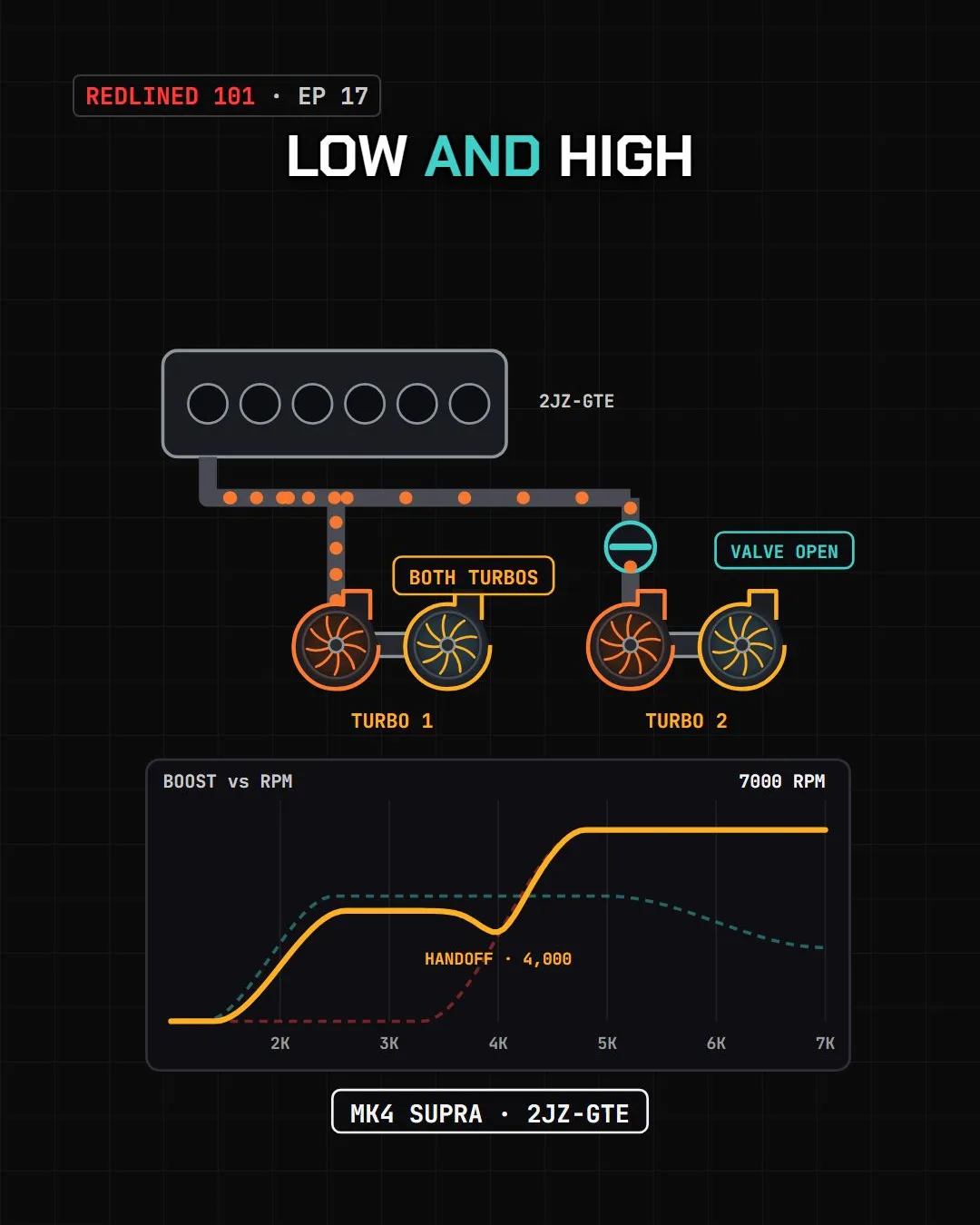
Now the trick. Sequential twins use two turbos in stages, controlled by valves:
- At low revs, a valve sends all the exhaust to just one turbo. With every bit of exhaust going through one turbine, it spools like a small one.
- Around 4,000 rpm, the valve opens and the second turbo joins in. Now both are working, and the engine breathes like it has a big one.
That's how the MK4 Supra's 2JZ hits low and pulls high. You get early boost from one turbo and top-end breathing from two.
Not every twin-turbo setup works this way. Many engines run parallel twins, where each turbo is fed by its own share of the cylinders and both spool together. Two smaller turbos each spool faster than one big one, but there's no switching. Sequential is the clever version, and the complicated one.
The catch: plumbing
All those valves and pipes. To switch between one turbo and two, a sequential system needs control valves, a bypass valve, crossover piping, wastegate control and a nest of vacuum lines to run it all. (A wastegate is the valve that lets some exhaust skip the turbine, so boost doesn't climb past its target.)
Every one of those is something that can leak, stick or crack with age, and a sequential setup that isn't switching cleanly feels worse than either a small or a big single.
That's why so many tuned Supras ditch the twins for one big single, and live with the lag. Simpler plumbing, more peak power, and a big turbo that pulls hard once it's on boost.
So which turbo setup suits you?
- Small single: boost early, easy to drive, great response on the street. Runs out of air up top.
- Big single: lag down low, but the most power at high rpm. The dyno-sheet hero.
- Sequential twins: early boost and top-end power, at the cost of complexity.
When people talk about turbo size, they're really talking about where in the rev range they want the power. Remember horsepower vs torque: low-rpm boost is the shove you feel around town, high-rpm boost is the horsepower that wins on the dyno. Turbo size is choosing which one you'd rather have.
Lag also isn't the only thing that happens between shifts. When you lift, the turbo slows down, and the boost you've built has to go somewhere. That's what a blow-off valve handles. And some cars go further and keep the turbo spinning off the gas altogether, which is a whole different story: anti-lag vs two-step vs pops and bangs.
The verdict
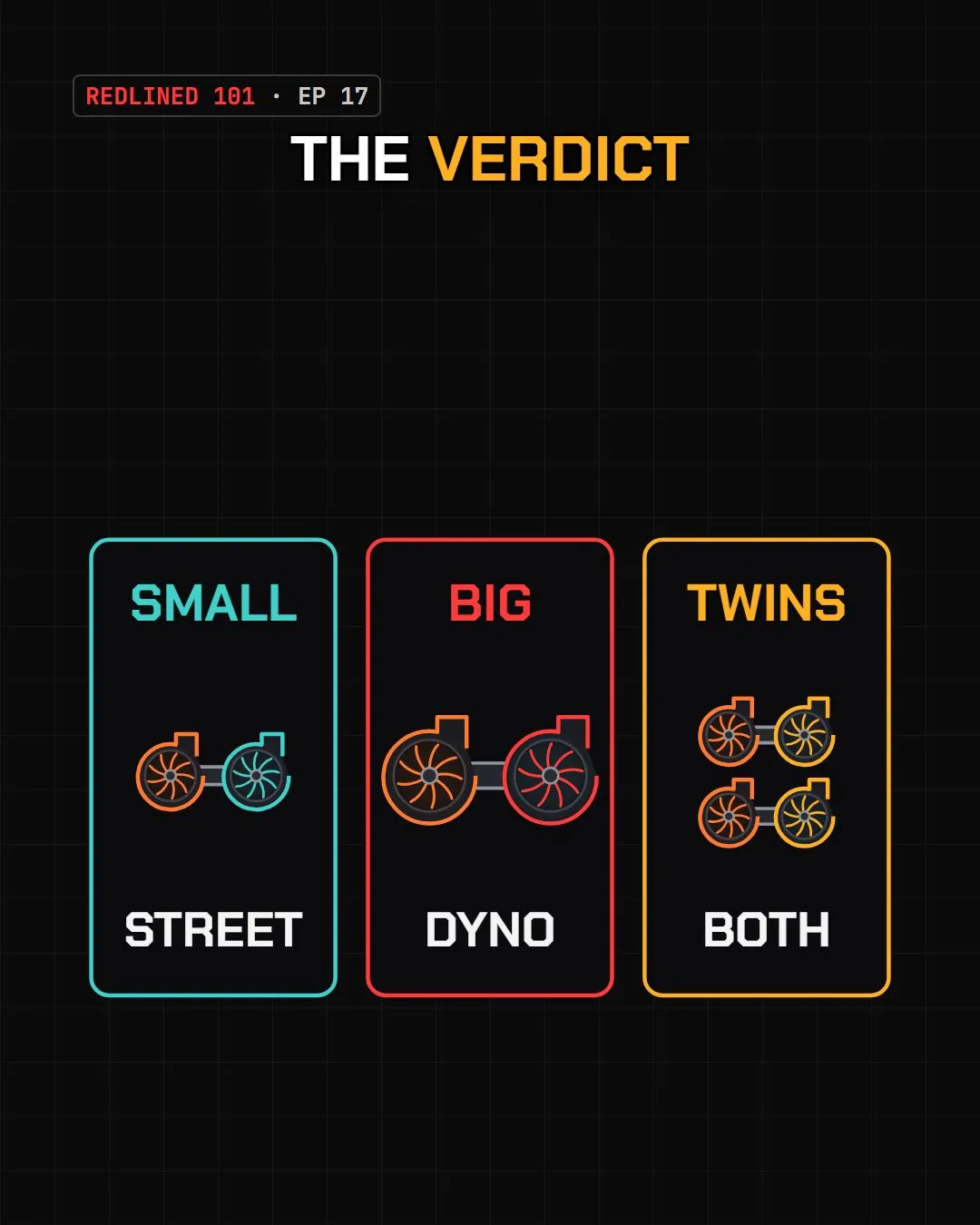
Small for the street, big for the dyno, twins for both.
So next time your buddy brags about his big single, ask him what it makes at 3,000 rpm.
Recap: small vs big vs twin turbo
- Small turbo: light wheels, full boost by about 2,500 rpm, but it runs out of breath and chokes the exhaust up top.
- Big turbo: heavy wheels, almost nothing until about 4,000 rpm (turbo lag), then the hardest pull to redline.
- Sequential twins: one turbo at low revs, both above about 4,000 rpm. Low-end response and top-end power.
- The catch: valves, pipes and vacuum lines, which is why many tuned Supras swap to a big single.
What's yours running: small, big, or twins?
Next episode: open vs limited-slip vs welded diff.
Frequently asked questions
Is a small turbo or a big turbo better?
It depends on what you want. A small turbo boosts early and suits the street but runs out of air at high rpm. A big turbo lags but makes the most power up top. Small for the street, big for the dyno.
What causes turbo lag?
A turbo is spun by exhaust gas, and heavier wheels need more exhaust flow before they spin fast enough to make boost. A big turbo makes almost nothing until the engine is producing a flood of exhaust, so you wait for it.
What are sequential twin turbos?
Two turbos run in stages. At low revs a valve sends all the exhaust to one turbo so it spools quickly, like a small one. Higher up, around 4,000 rpm in the MK4 Supra's 2JZ, the valve opens and the second turbo joins in, so it breathes like a big one.
Why do people convert twin turbo Supras to a single turbo?
Sequential twins need a lot of valves, pipes and vacuum lines to switch between turbos. A big single is simpler and makes more peak power, so many tuners accept the extra lag.
Do twin turbos spool faster than a single turbo?
Compared with one big turbo, yes, if they're set up right. Sequential twins make low-rpm boost from one turbo first. Compared with a small single, not necessarily: the small single will still spool very early, it just runs out of air sooner.
Official merch
Shop the club merch
3 Pedals 0 F*cks Manual Transmission on a Unisex Oversized Heavyweight T-Shirt, black
Unisex Oversized Heavyweight T-Shirt
from $38.49
Pork Roll, Egg, Cheese & Boost – Jersey Breakfast on a Unisex Oversized Heavyweight T-Shirt, black
Unisex Oversized Heavyweight T-Shirt
from $32.99
My Toxic Trait: One More Project Car on a Unisex Oversized Heavyweight T-Shirt, black
Unisex Oversized Heavyweight T-Shirt
from $32.99
+1000 Aura – Exhaust Flames Car Shirt on a Unisex Oversized Heavyweight T-Shirt, white
Unisex Oversized Heavyweight T-Shirt
from $32.99
Unc Can Still Heel-Toe – Manual Driver Shirt on a Unisex Oversized Heavyweight T-Shirt, black
Unisex Oversized Heavyweight T-Shirt
from $32.99
But Officer The Sign Said Slide It on a Unisex Oversized Heavyweight T-Shirt, white
Unisex Oversized Heavyweight T-Shirt
from $32.99
Redlined Car Club Est. 2023 Brushmark on a Unisex Oversized Heavyweight T-Shirt, black
Unisex Oversized Heavyweight T-Shirt
from $32.99
Car Guy By Definition on a Unisex Oversized Heavyweight T-Shirt, black
Unisex Oversized Heavyweight T-Shirt
from $32.99
Tokyo Retro Vibes on a Unisex Oversized Heavyweight T-Shirt, black
Unisex Oversized Heavyweight T-Shirt
from $32.99
BOSOZOKU CARSPANK ボ — ソ — 族 — 車 の ス パ ン ク on a Unisex Oversized Heavyweight T-Shirt, black
Unisex Oversized Heavyweight T-Shirt
from $32.99
Coilovers > 401K – Funny Car Guy on a Unisex Oversized Heavyweight T-Shirt, black
Unisex Oversized Heavyweight T-Shirt
from $32.99
Can't Pump Gas, Can Swap A Motor – NJ Car Guy on a Unisex Oversized Heavyweight T-Shirt, black
Unisex Oversized Heavyweight T-Shirt
from $32.99




More from the club
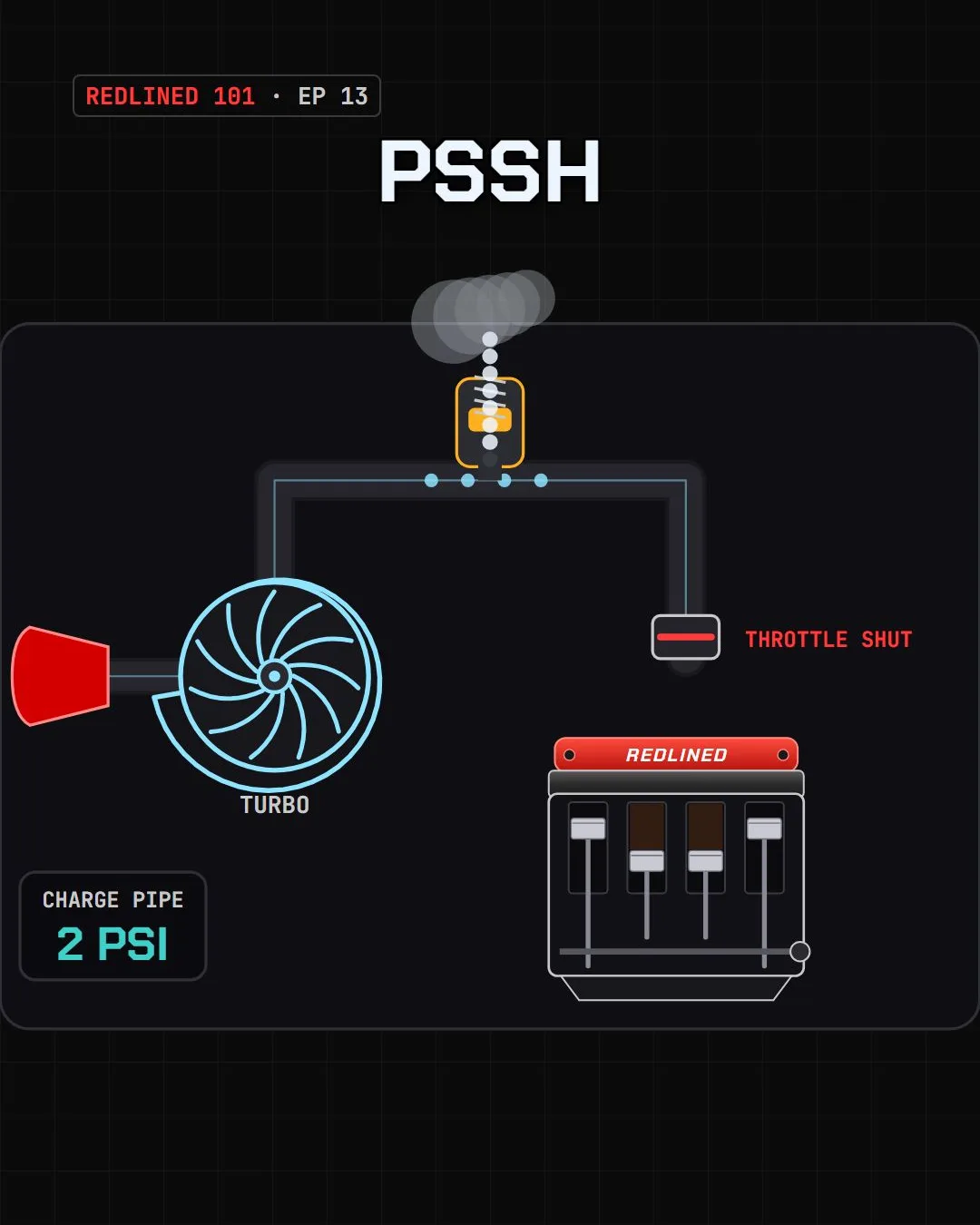
Blow-Off Valve vs Turbo Flutter: Pssh or Stu-tu-tu? (Redlined 101, Ep 13)
Why a turbo car makes a sound when you lift, how a blow-off valve and a diverter valve vent boost, what compressor surge (turbo flutter) is, what it costs the turbo, and why a loud blow-off valve can make a car stumble.
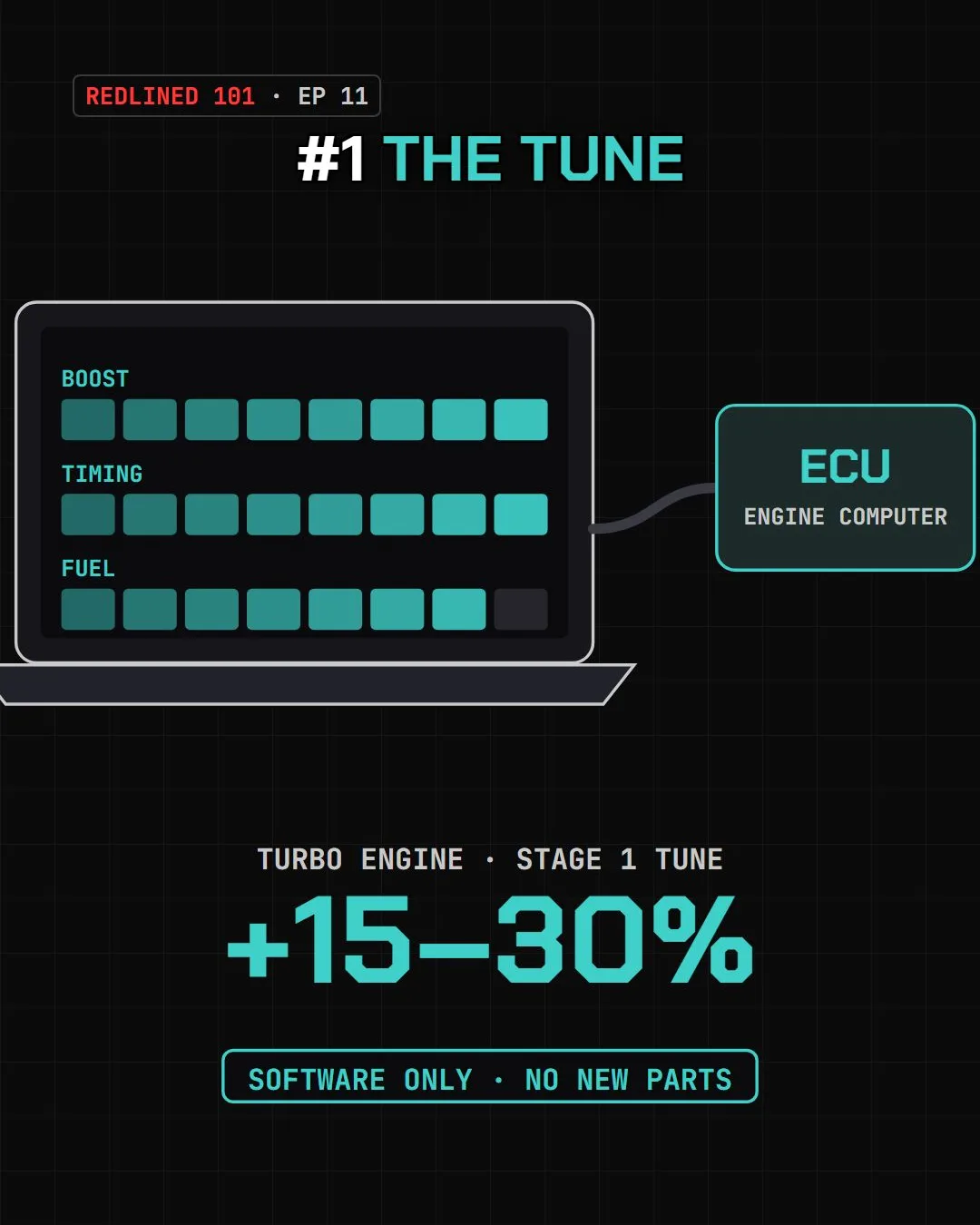
Intake vs Exhaust vs Tune: Which Car Mods Actually Add Horsepower? (Redlined 101, Ep 11)
What a cold air intake, a cat-back exhaust and an ECU tune really do on the dyno, why builds go in stages, how tires and weight make a car faster for free, and the catch that comes with more power.
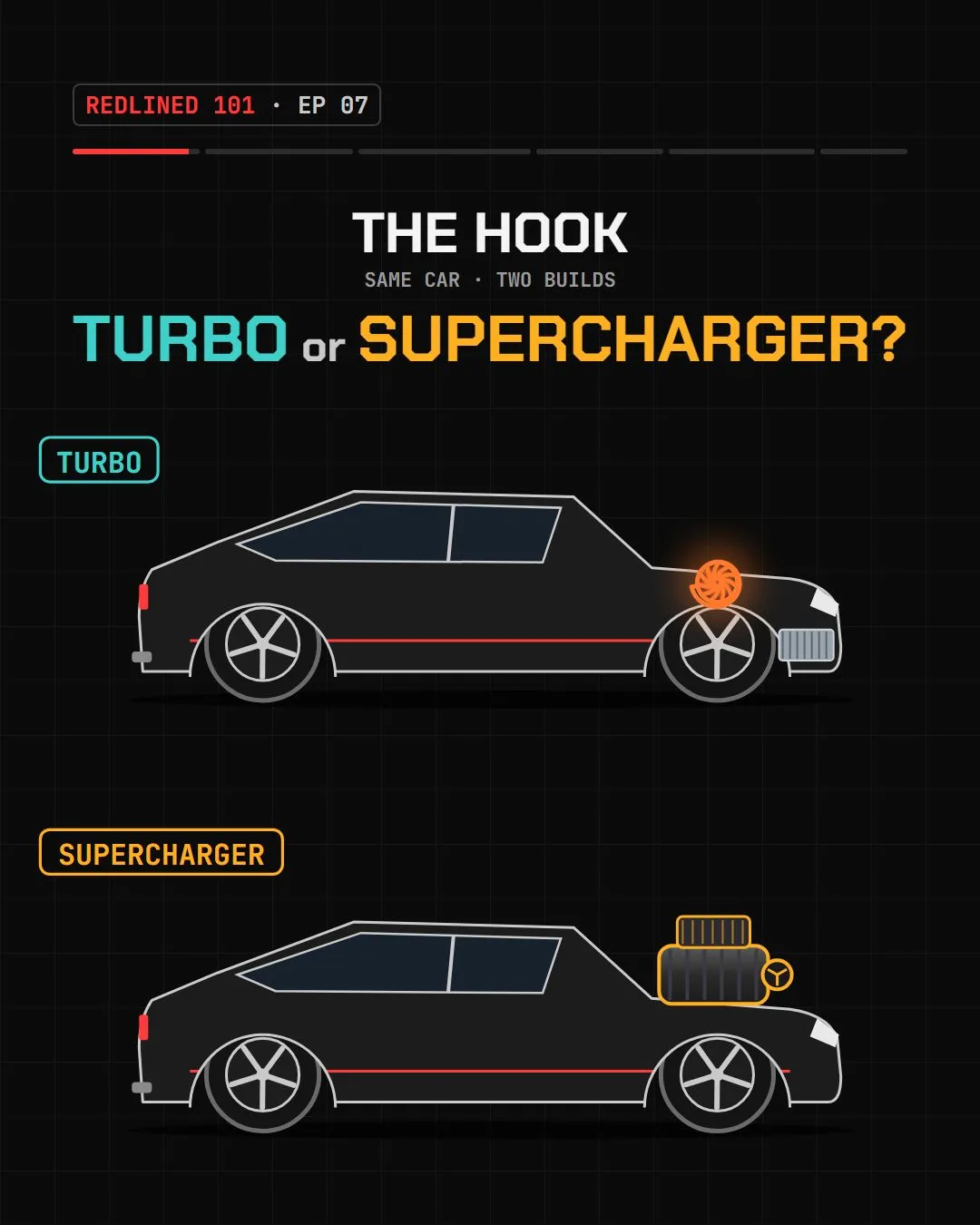
Turbo vs Supercharger: What's the Difference and Which Is Better? (Redlined 101, Ep 07)
Turbo vs supercharger: what boost is, the one thing that separates them (exhaust or a belt off the crank), why that changes how each one feels and sounds, and which one fits a daily driver or an instant-punch build.