Turbo vs Supercharger: What's the Difference and Which Is Better? (Redlined 101, Ep 07)
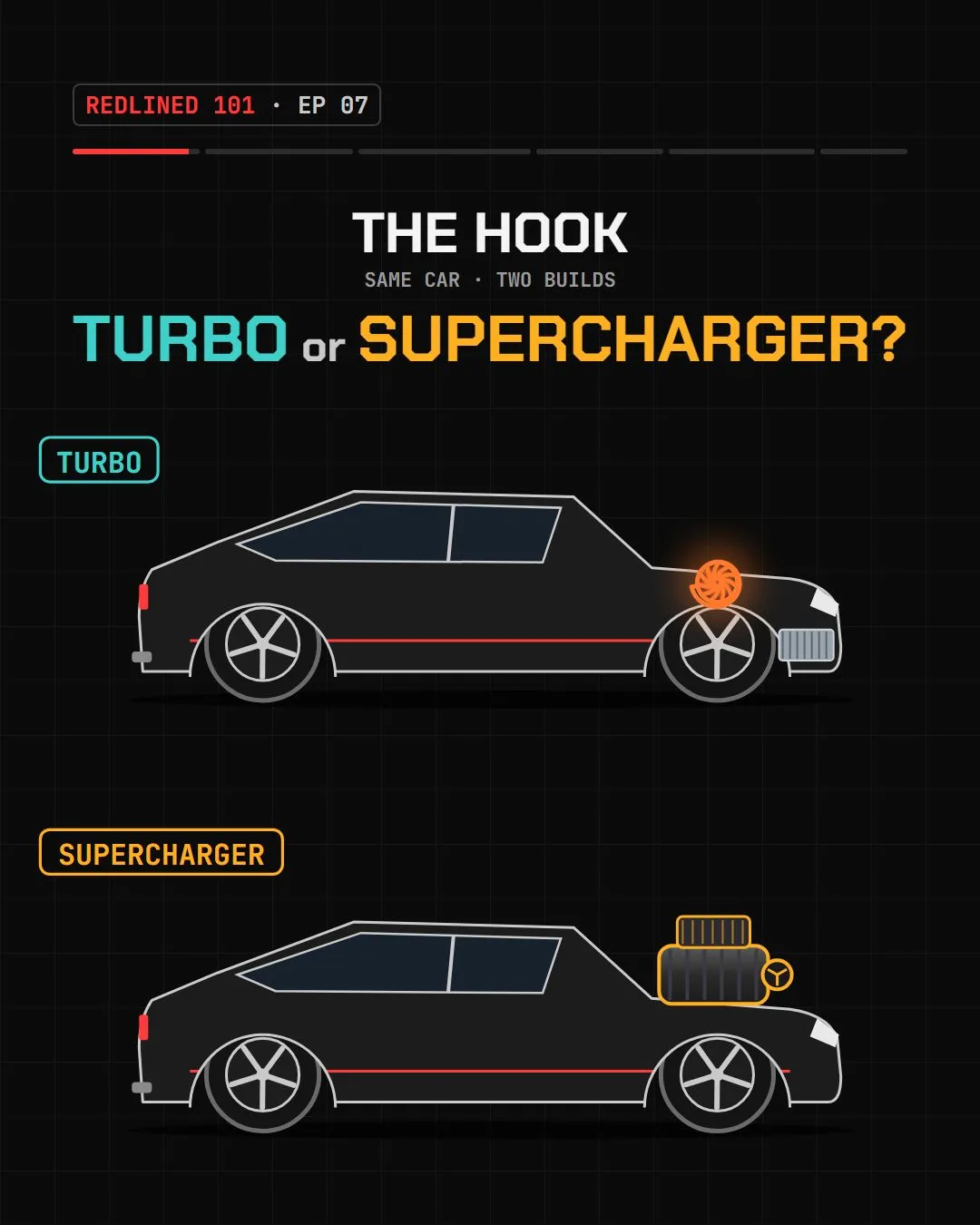
Turbo or supercharger? Put each one on the same car, at the same boost, and they'll still feel completely different. One thing decides how it feels, and once you know it, the lag, the sound and the "which one should I buy" question all make sense.
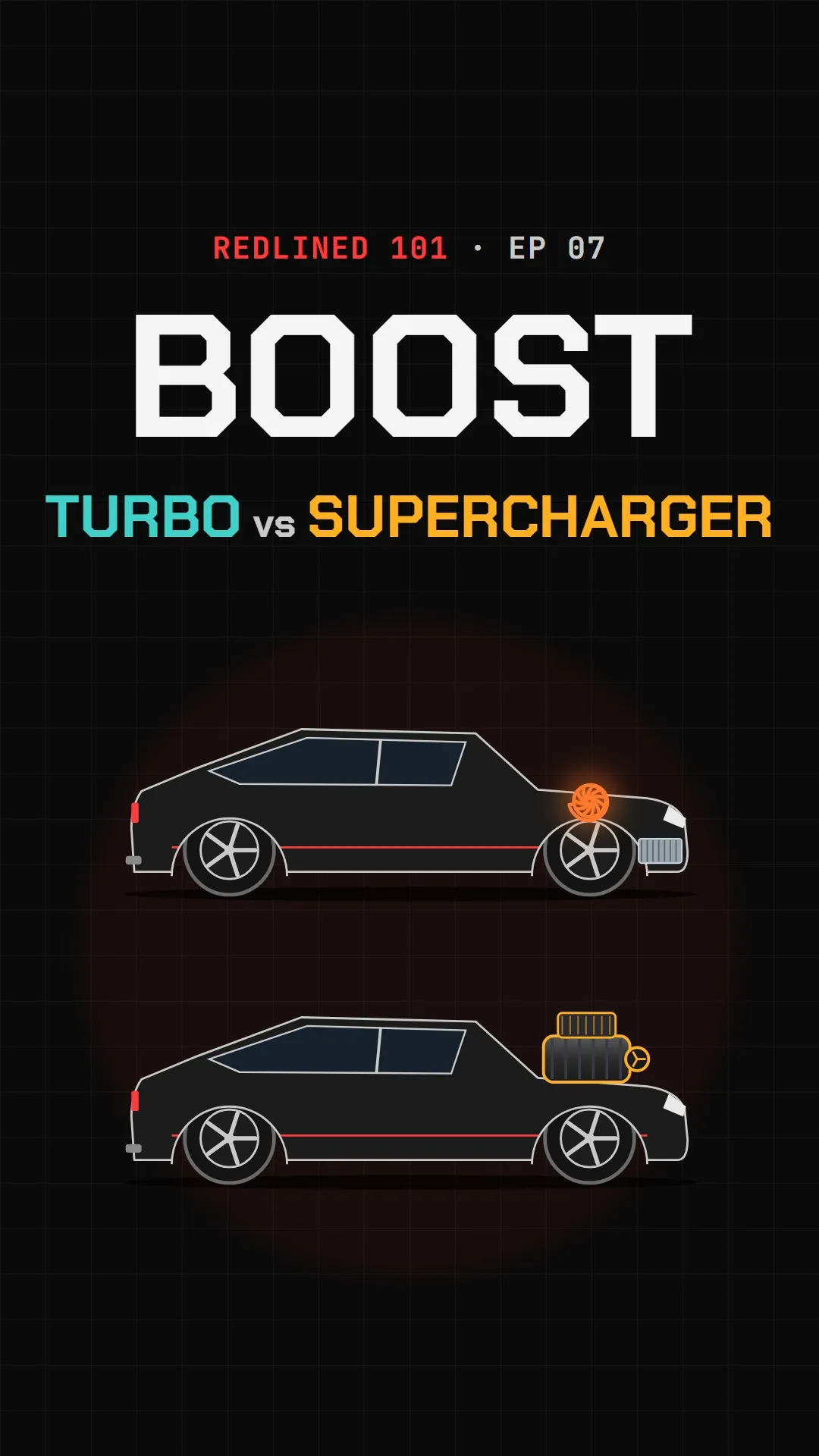 Watch on Instagram
First: what boost is
An engine makes power by burning fuel with air. More air lets it burn more fuel, and more fuel burned is more power. A normal engine only gets the air it can suck in on its own.
Both turbos and superchargers are air pumps. They squeeze extra air into the engine, and the extra pressure they build in the intake is called boost, usually measured in psi or bar. Same car, same boost: both builds are pushing the same pressure into the engine. So why do they feel so different?
The one thing: what spins it
That's it. That's the whole difference.
- A turbo is spun by your exhaust. The hot exhaust leaving the engine flows through a small turbine wheel. That turbine sits on a shaft with a compressor wheel on the other end, and the compressor pushes air into the intake. The engine's own waste gas powers its boost.
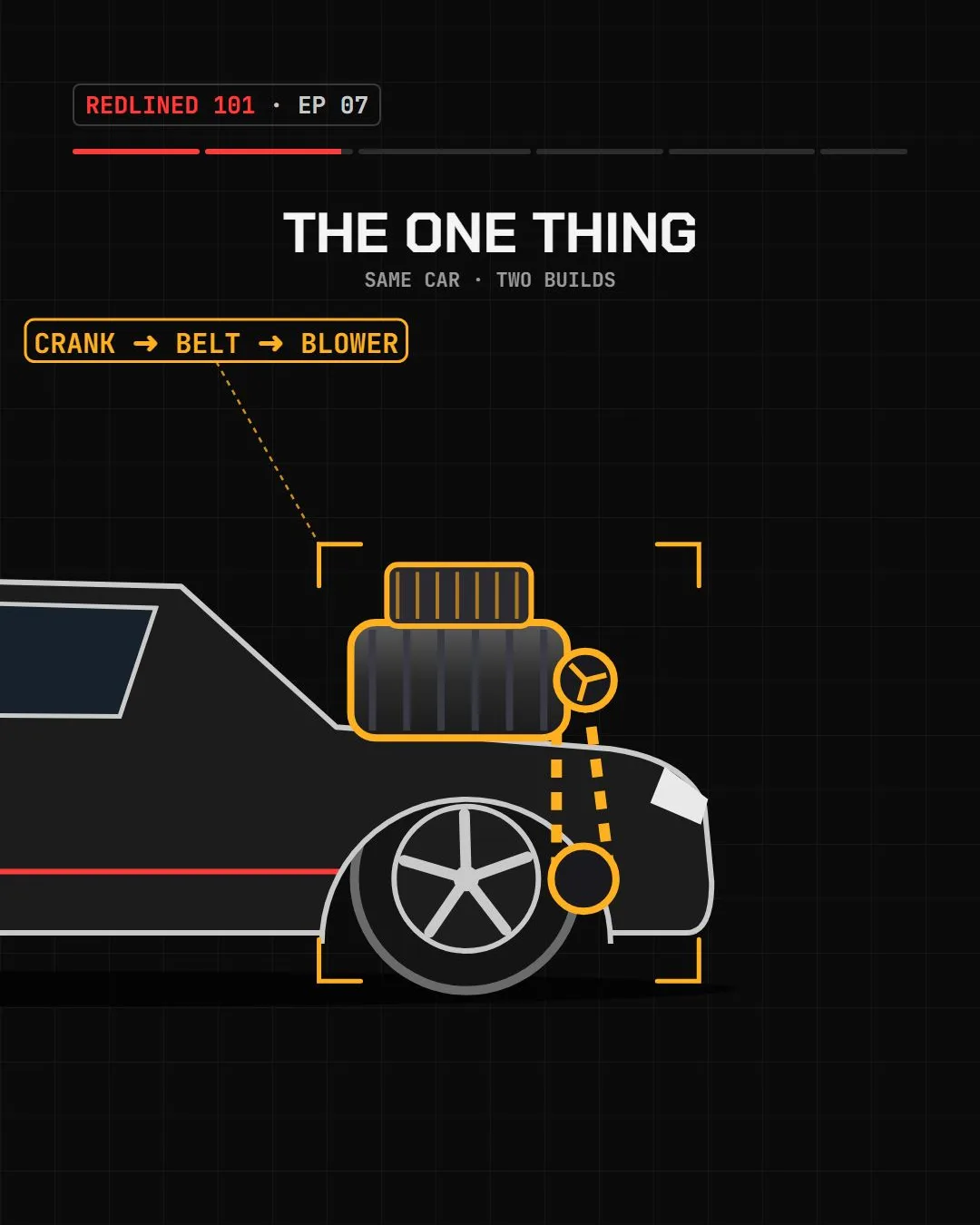
- A supercharger is spun by a belt off the crank. The crankshaft drives a pulley, the pulley drives a belt, and the belt drives the blower. Crank, belt, blower. It's mechanically tied to the engine, like the alternator.
Everything else in this post follows from that one difference.
The feel: instant punch vs pulling up top
When you stab the throttle, the two react differently.
The supercharger makes boost instantly. It's belted to the crank, so the moment the engine turns faster, the blower turns faster. There's nothing to wait for. Power is strong everywhere in the rev range, from just off idle.
The turbo waits for exhaust. At low revs and light throttle there isn't much exhaust flowing, so the turbine isn't spinning fast enough to make real boost. Floor it and the engine has to make more exhaust first, then the turbo spins up, then the boost arrives. That wait is turbo lag. Once it's spinning, though, the turbo pulls harder up top, where there's plenty of exhaust to drive it.
On a power-vs-RPM chart, that looks like two different shapes: the supercharger is a steady line that's strong everywhere, and the turbo starts low, then climbs steeply and finishes higher.
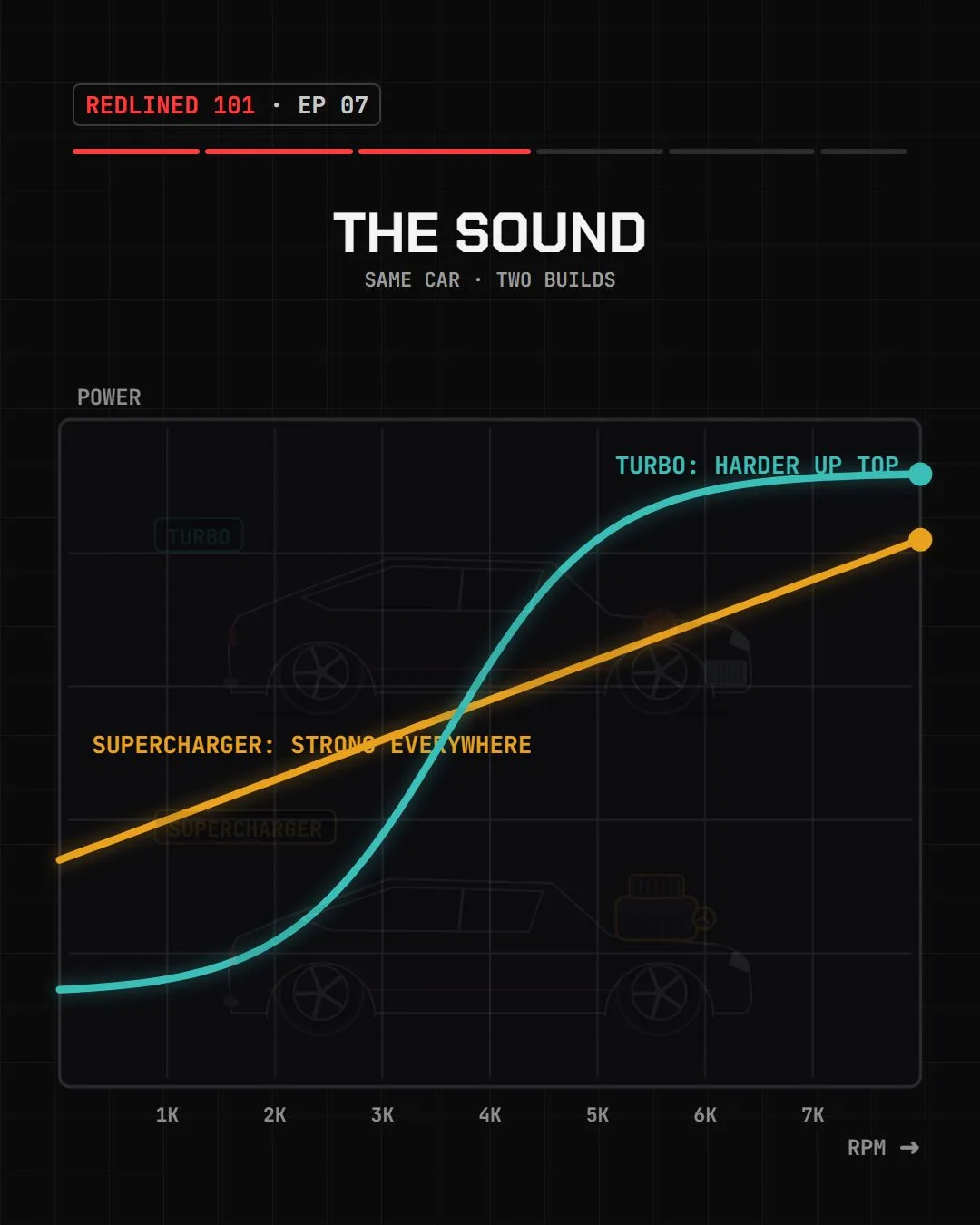
A couple of honest footnotes to that picture:
- Not every supercharger is instant. The classic blower on the hood, the kind in the diagrams, is a positive-displacement type that moves a set amount of air every turn, so boost is there right away. Centrifugal superchargers, which look more like a turbo's compressor, build boost with the revs instead.
- Not every turbo is laggy. Turbo size, setup and tuning decide how early it spins up. We go deep on that in small turbo vs big turbo vs twin-turbo.
There's also a cost to the supercharger's instant response: because it's driven off the crank, it takes some of the engine's power to spin it. A turbo runs on exhaust energy the engine was throwing away anyway.
The sound: whoosh vs whine
That's why they sound different.
Turbos whoosh and flutter. The whoosh is the turbo spooling up and moving air. The flutter is what you hear when you lift off the throttle: the throttle shuts, and the pressurized air has nowhere to go. A blow-off valve vents it with a pssh; without one, it chatters back through the turbo. That's its own episode: blow-off valve vs turbo flutter.
Superchargers whine. The blower's rotors or gears are spinning in step with the engine, so you get a mechanical whine that rises and falls with the revs. Some people buy a supercharger for that sound alone.
What else comes with each one
The pump is only part of the kit. Because of where each one gets its power, they bring different hardware with them.
A turbo lives in the exhaust. It bolts to the exhaust side of the engine, so a turbo setup usually means:
- An exhaust manifold or downpipe shaped to feed it.
- An oil (and often coolant) line to the turbo, because that shaft spins very fast next to very hot exhaust.
- A wastegate, a valve that lets some exhaust bypass the turbine so boost doesn't keep climbing past the target.
- A blow-off or bypass valve to vent pressure when you lift.
A supercharger lives on the belt. It's driven off the crank, so the kit is mostly the blower itself, a pulley and belt, and the intake plumbing. On the classic hood-mounted type there's no exhaust work at all. Boost is set largely by the pulley size: a smaller pulley spins the blower faster for more boost.
Both make hot air. Squeezing air heats it, and hot air is less dense, which costs power and makes the engine more prone to knock. That's why boosted setups often add an intercooler to cool the charge before it reaches the engine.
None of this makes one better than the other. It's just why the price, the install and the sound of each build are so different, even at the same boost.
Which one should you pick?
The episode's verdict comes down to how you drive and what you want to hear:
- Daily driver chasing top end? Turbo. You'll live with a bit of lag in exchange for the big pull up top.
- Instant punch and that whine? Supercharger. Power the moment you touch the pedal, and a soundtrack to go with it.
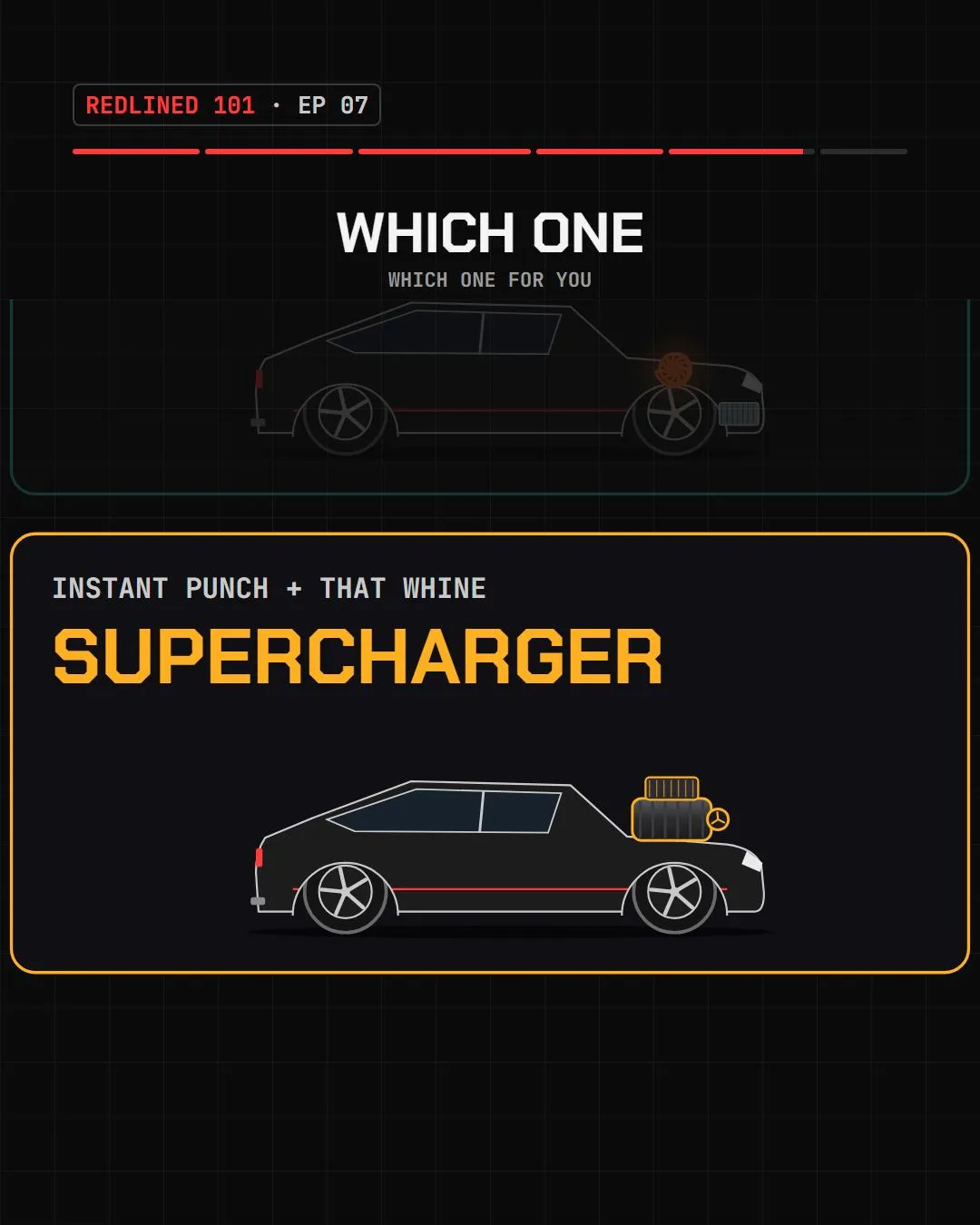
Before you pick either
Whichever you choose, adding boost to an engine isn't just bolting on the pump. More air means more fuel and a tune to match, and the engine, clutch and cooling all have to handle the extra power. If you're still working out what makes power in the first place, start with horsepower vs torque and the car mods that actually add horsepower.
Recap
- Both are air pumps that push boost into the engine.
- The one thing: a turbo is spun by exhaust; a supercharger is spun by a belt off the crank.
- The feel: the supercharger makes boost instantly; the turbo waits for exhaust, then pulls harder up top.
- The sound: turbos whoosh and flutter; superchargers whine.
- The pick: daily driver chasing top end, turbo. Instant punch and the whine, supercharger.
So which camp are you in: turbo or supercharger?
Next episode: manual vs paddle shift.
Frequently asked questions
What is the difference between a turbo and a supercharger?
What spins it. A turbocharger is spun by the engine's exhaust gas; a supercharger is spun by a belt off the crankshaft. Both compress air into the engine to make more power.
Which is faster, a turbo or a supercharger?
At the same boost, the difference is mostly how the power arrives. A supercharger makes boost the instant you hit the throttle; a turbo has to wait for exhaust, then pulls harder up top.
What is turbo lag?
The delay between pressing the throttle and the turbo making boost. The turbo is spun by exhaust, so it needs the engine to produce enough exhaust flow before it can spin up.
Why do superchargers whine?
The supercharger is driven straight off the crank, so its rotors or gears spin with the engine and make a whine that rises with the revs. Turbos make a whoosh, and a flutter when you lift off.
Is a turbo or supercharger better for a daily driver?
The episode's pick for a daily driver chasing top end is a turbo. If you want instant punch and that whine, go supercharger.
Official merch
Shop the club merch
REDLINED Racer on a Unisex Oversized Heavyweight T-Shirt, black
Unisex Oversized Heavyweight T-Shirt
from $44.99
REDLINED Built, Not Bought on a Unisex Oversized Heavyweight T-Shirt, black
Unisex Oversized Heavyweight T-Shirt
from $44.99
REDLINED Tach on a Unisex Oversized Heavyweight T-Shirt, black
Unisex Oversized Heavyweight T-Shirt
from $44.99
REDLINED Turbo on a Unisex Oversized Heavyweight T-Shirt, black
Unisex Oversized Heavyweight T-Shirt
from $44.99
REDLINED Drift on a Unisex Oversized Heavyweight T-Shirt, black
Unisex Oversized Heavyweight T-Shirt
from $44.99
REDLINED Night Run on a Unisex Oversized Heavyweight T-Shirt, black
Unisex Oversized Heavyweight T-Shirt
from $44.99
My Toxic Trait: One More Project Car on a Unisex Oversized Heavyweight T-Shirt, black
Unisex Oversized Heavyweight T-Shirt
from $39.49
+1000 Aura – Exhaust Flames Car Shirt on a Unisex Oversized Heavyweight T-Shirt, white
Unisex Oversized Heavyweight T-Shirt
from $39.49
Unc Can Still Heel-Toe – Manual Driver Shirt on a Unisex Oversized Heavyweight T-Shirt, black
Unisex Oversized Heavyweight T-Shirt
from $39.49










More from the club
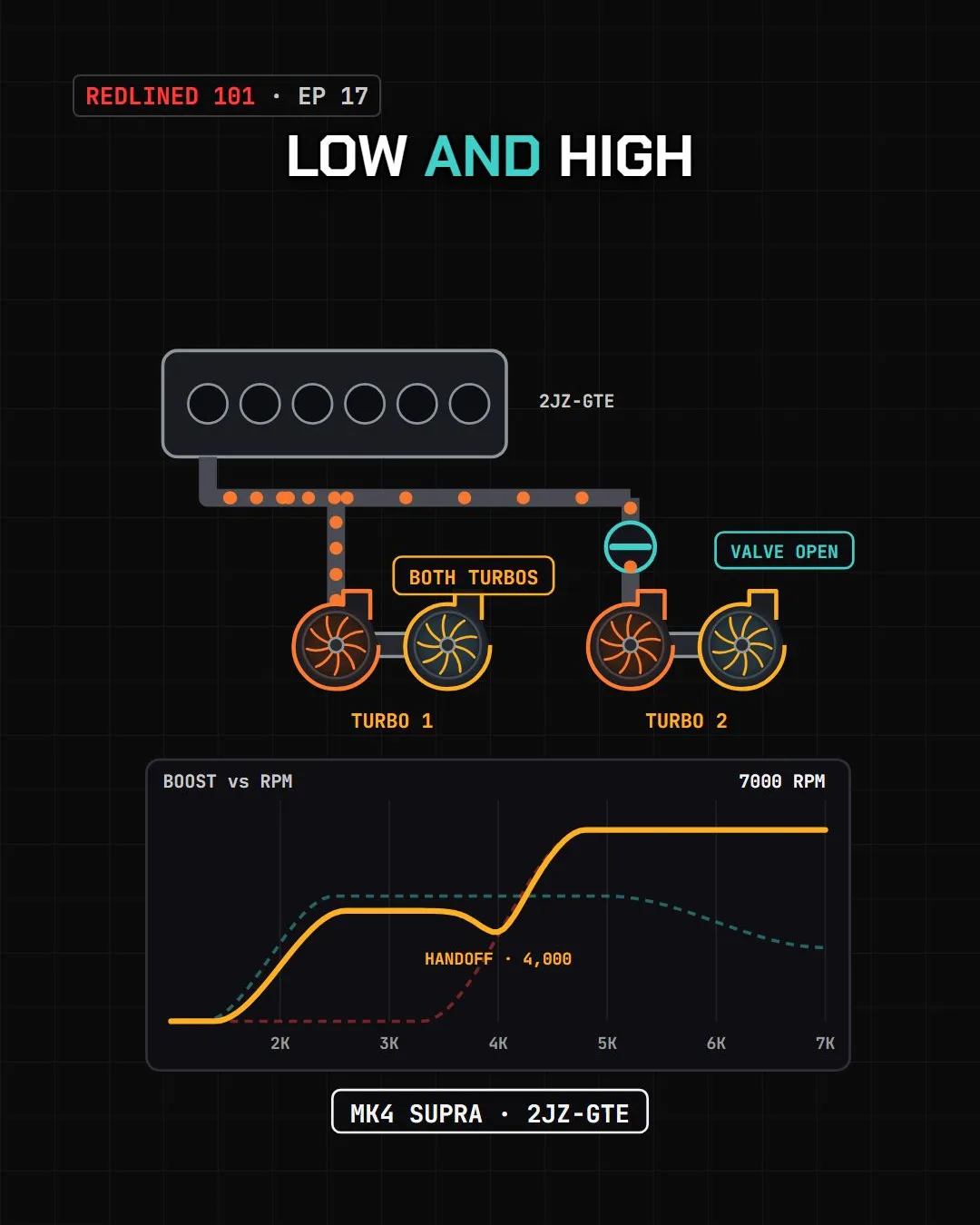
Small Turbo vs Big Turbo vs Twin Turbo: Lag, Spool and Sequential Twins (Redlined 101, Ep 17)
Why a small turbo boosts instantly but runs out of breath, why a big turbo lags then pulls hardest, how sequential twins like the MK4 Supra's 2JZ get both, and why so many tuners swap to one big single.
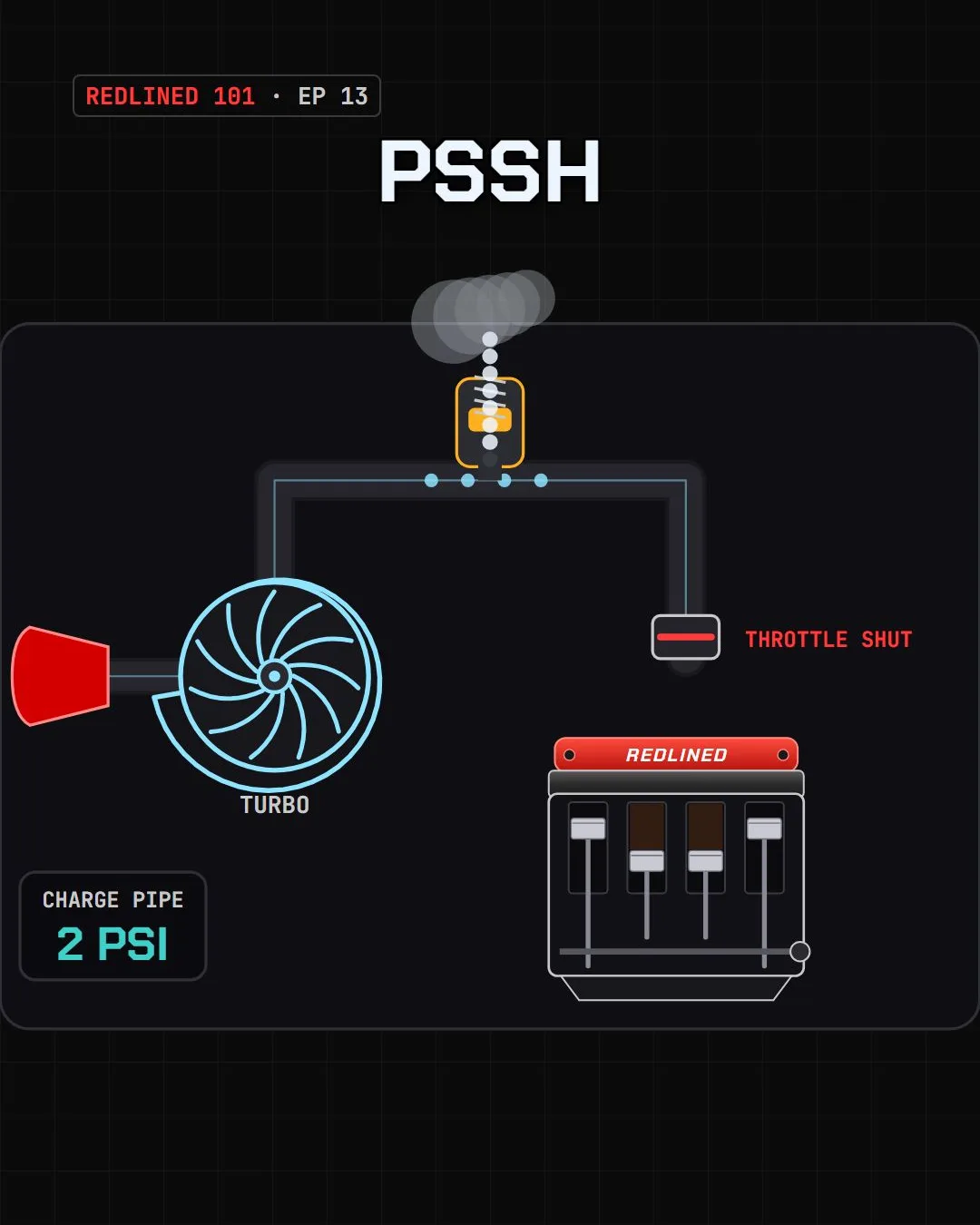
Blow-Off Valve vs Turbo Flutter: Pssh or Stu-tu-tu? (Redlined 101, Ep 13)
Why a turbo car makes a sound when you lift, how a blow-off valve and a diverter valve vent boost, what compressor surge (turbo flutter) is, what it costs the turbo, and why a loud blow-off valve can make a car stumble.
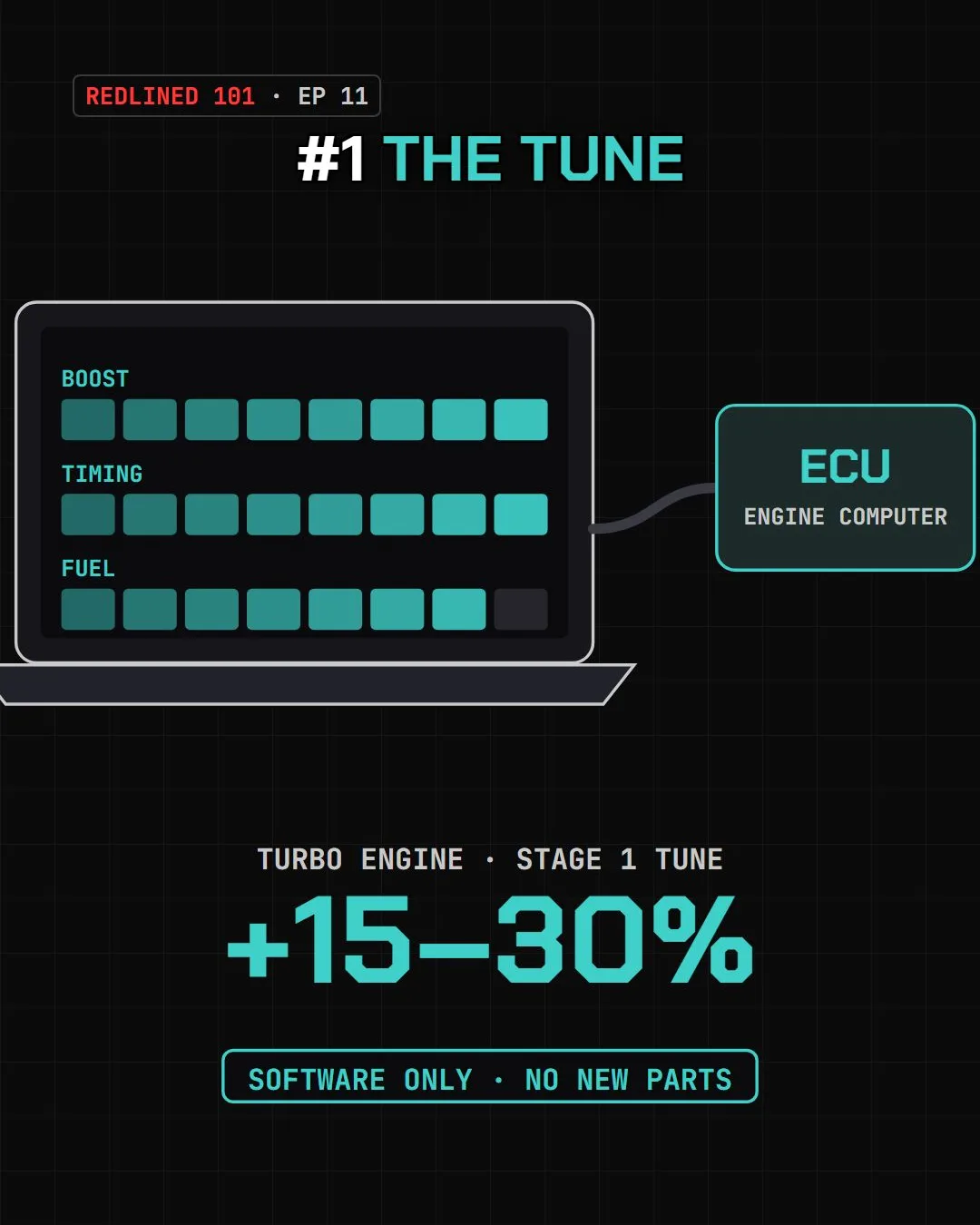
Intake vs Exhaust vs Tune: Which Car Mods Actually Add Horsepower? (Redlined 101, Ep 11)
What a cold air intake, a cat-back exhaust and an ECU tune really do on the dyno, why builds go in stages, how tires and weight make a car faster for free, and the catch that comes with more power.