
Wheel Offset Explained: ET, Poke, Flush and Tuck (Redlined 101, Ep 01)
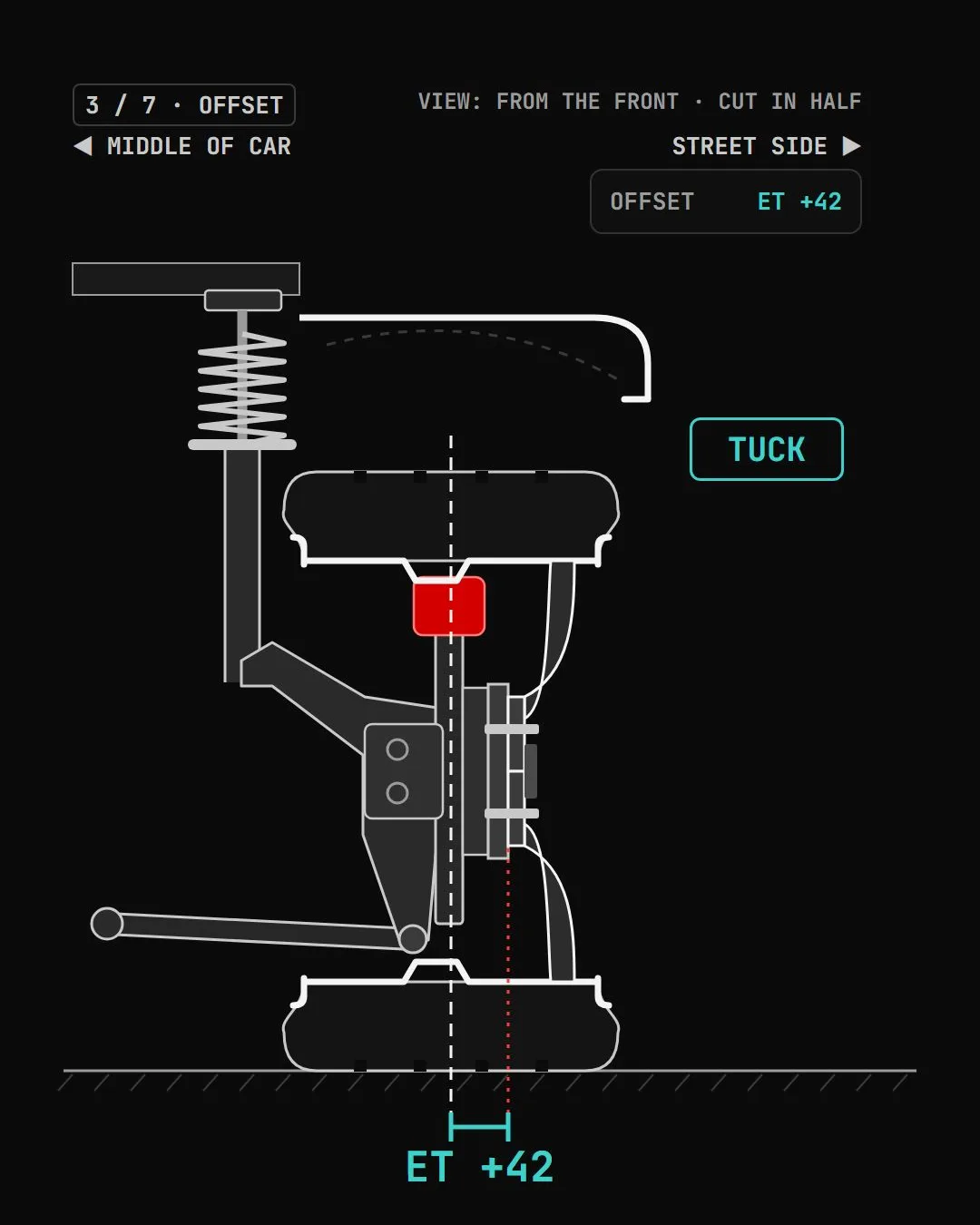
Same car, same tires. One sits wide and aggressive, the other tucks under the fenders. One number decides it: offset. Here's the whole thing, from the parts involved to what the community actually respects.
 Watch on Instagram
Where we're looking from
Every diagram here is drawn from the front of the car, looking at the wheel on the right of the picture. The middle of the car is to the left; the street side is to the right. Then we slice that corner in half, straight through the center of the wheel.
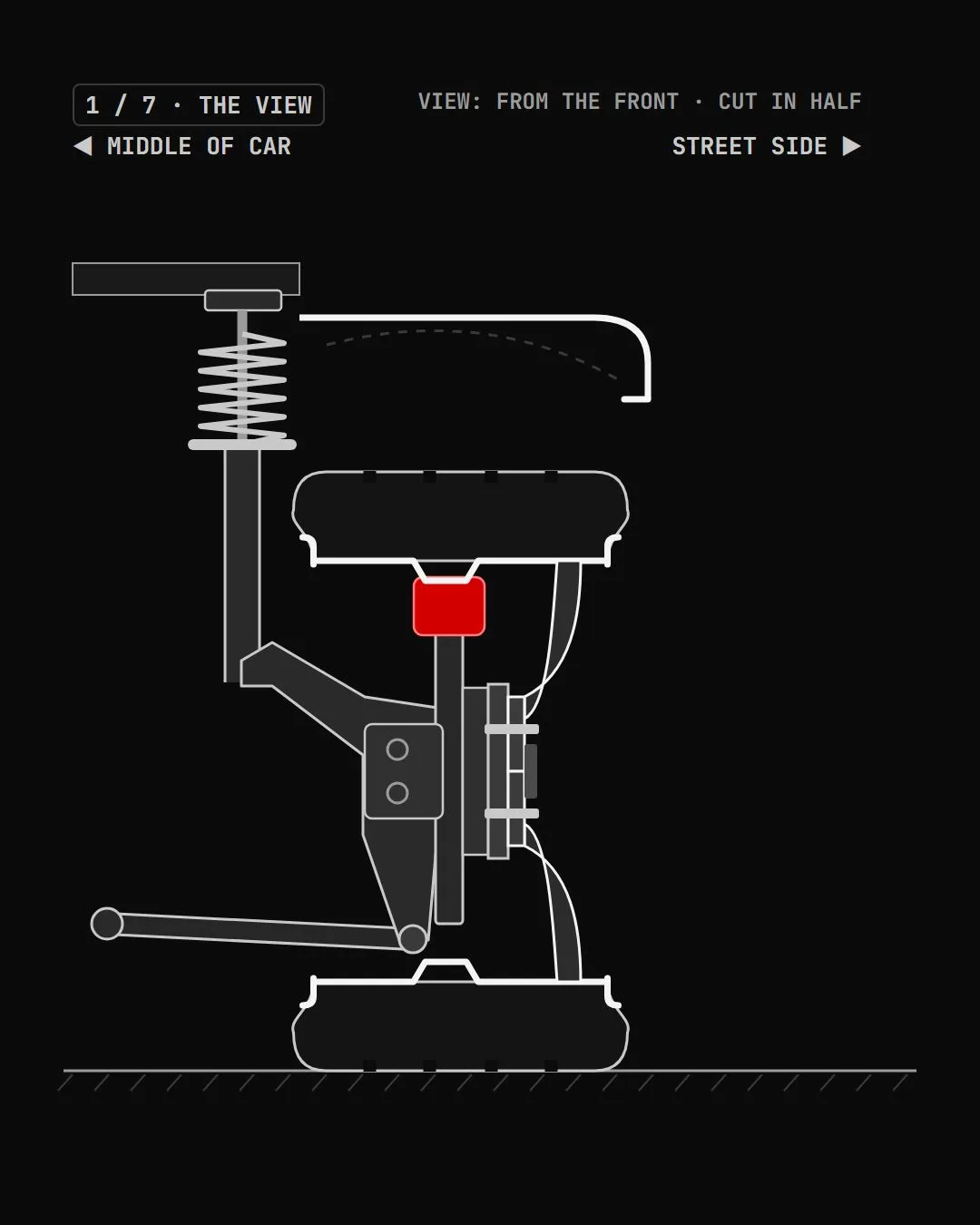
The parts
- The strut holds the car up.
- The hub is what the wheel bolts to, and it never moves.
- The wheel has an outer lip, a barrel that holds the tire, and a face with the spokes.
- The mounting pad is the flat surface on the back of the face that bolts against the hub.
What offset is
Draw a line down the middle of the wheel's width. That's the centerline. Offset is the distance from that centerline to the mounting pad, in millimeters. It's stamped on the wheel as ET (from the German Einpresstiefe), like the ET35 in episode zero.
- Positive offset: the pad sits street-side of the centerline. Higher numbers tuck the wheel in further.
- Negative offset: the pad sits behind the centerline, and the wheel pushes out. That's where deep, dished lips come from.
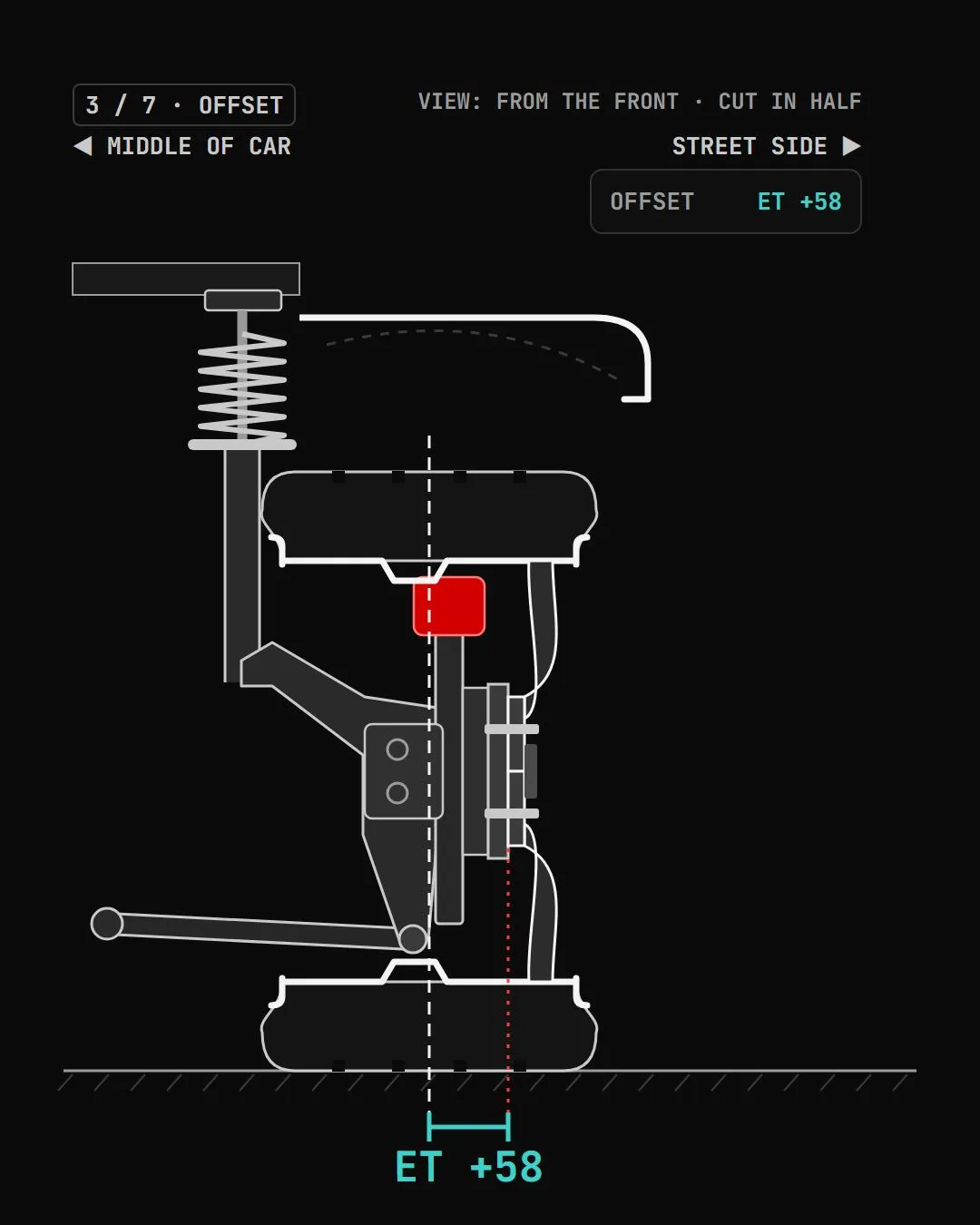
ET +58: high positive offset tucks the wheel in. 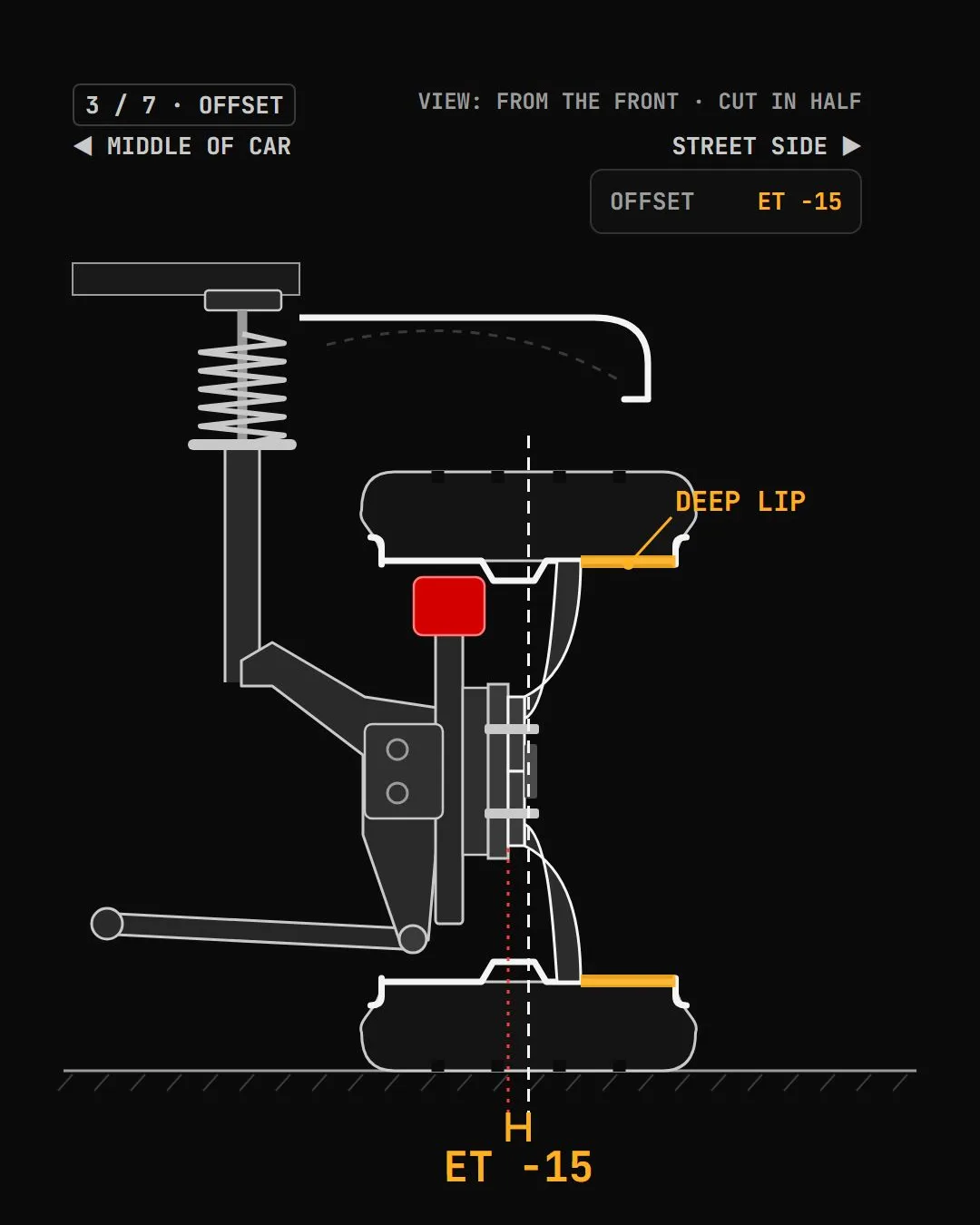
ET −15: negative offset pushes it out, and the lip gets deep. Compare the tire to the fender: poke, flush or tuck.
Now compare the tire to the fender. Sticking out past it is poke. Level with it is flush. Hidden underneath is tuck.
How suspension changes the fit
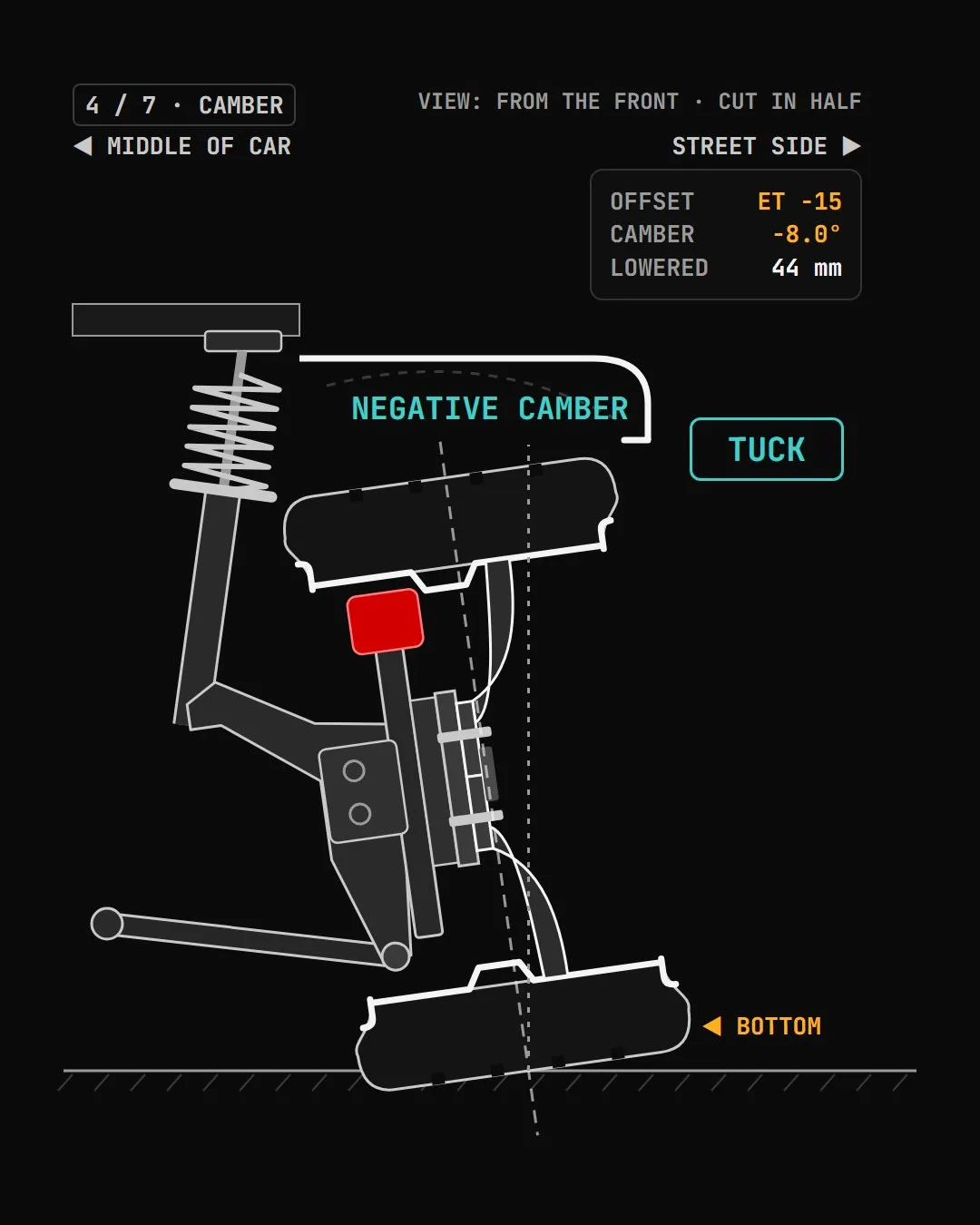
Here's what most people miss: lowering usually tilts the top of the wheel inward. That's negative camber, and it pulls the top of the tire away from the fender. It's how stance builds fit such aggressive wheels.
The cost is grip, and tire wear on the inner edge, so most street builds keep it mild. Episode three covers camber, toe and caster in full.
Why fender rolling matters
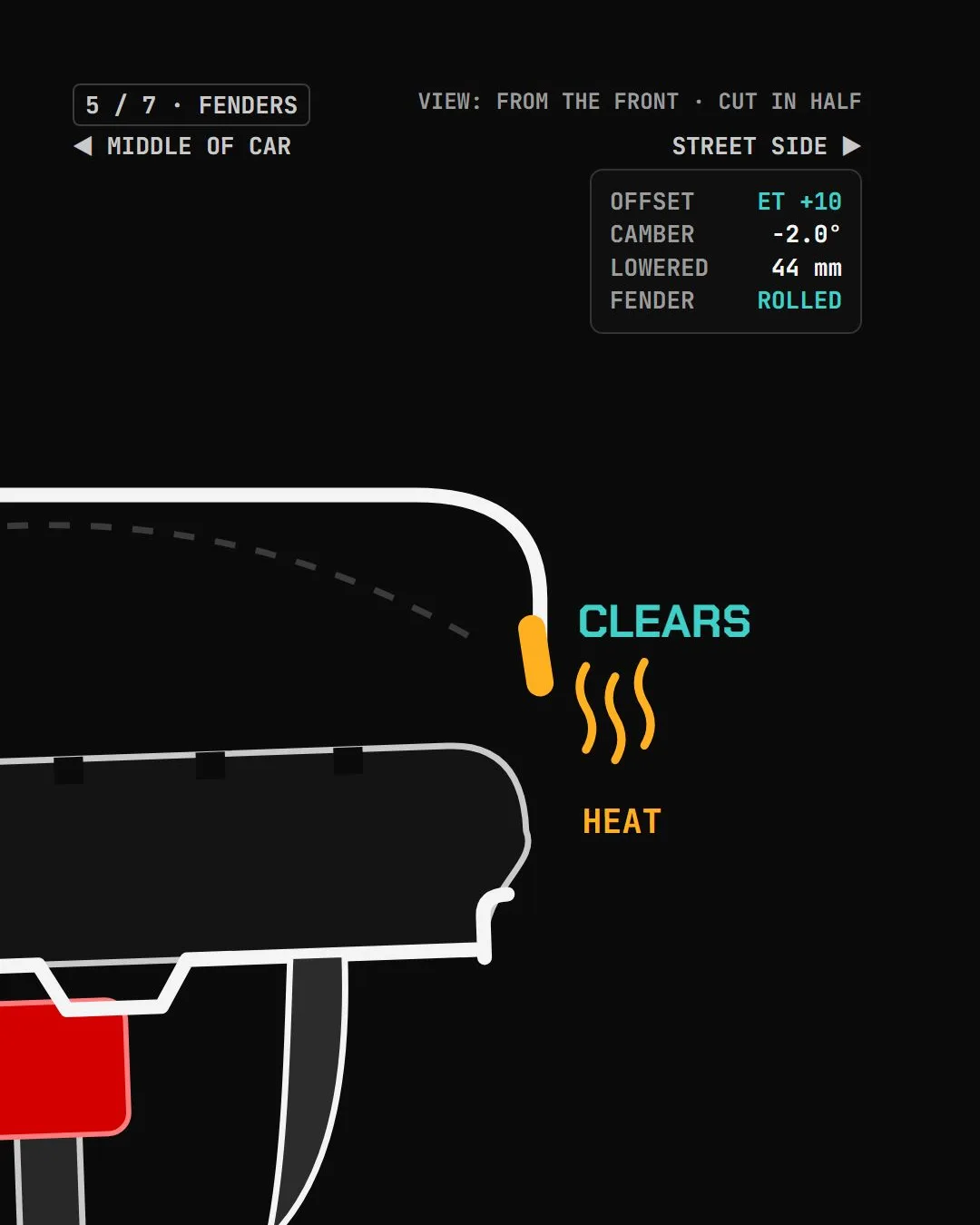
Every bump pushes the wheel up into the fender, and a lowered car has less room to give. Inside the fender is a folded lip of sheet metal. Hit it, and it can cut your tire or bend the fender.
Rolling the fender folds that lip flat for more clearance. Go slow, with heat, so the paint doesn't crack.
Respect vs. ricer
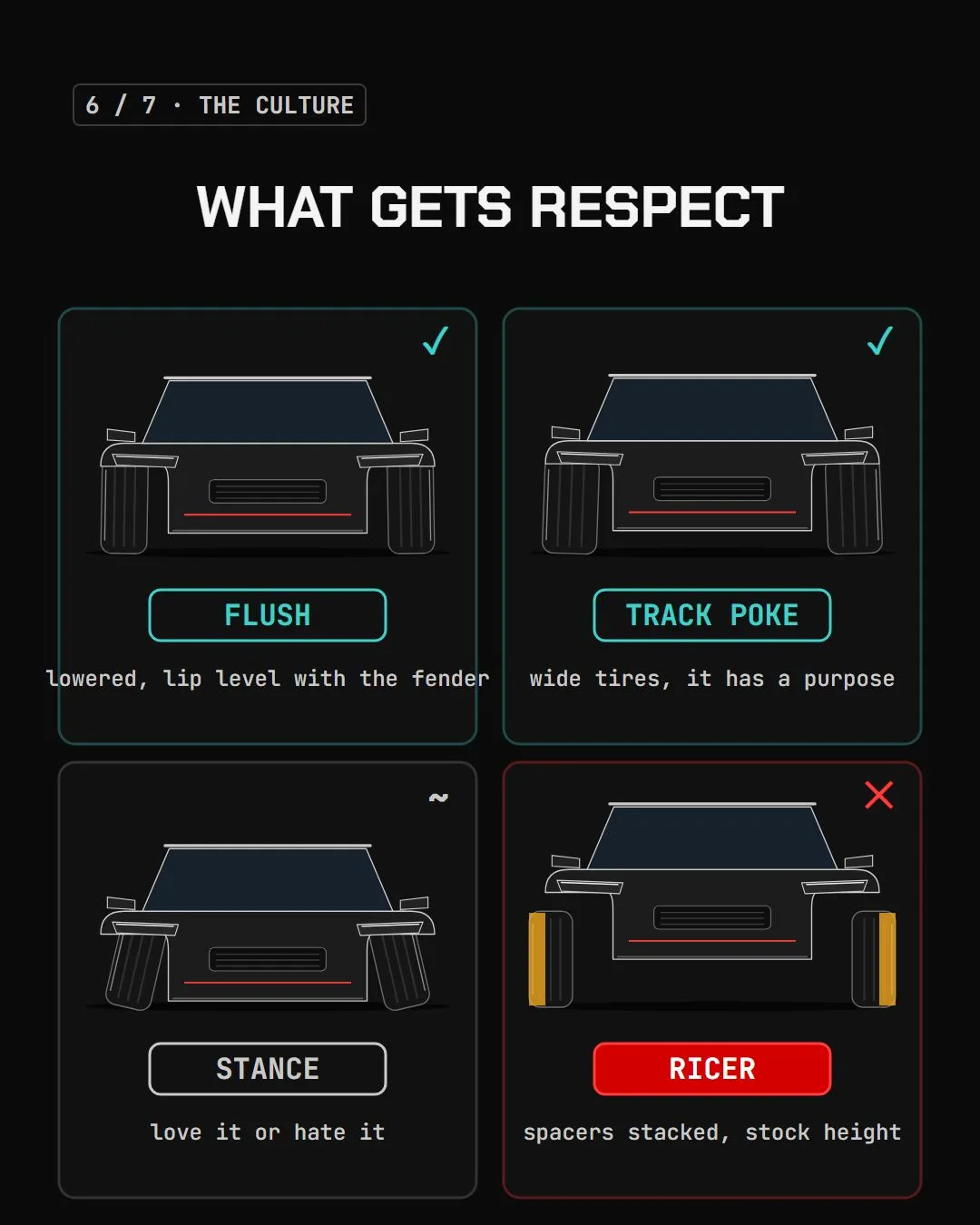
- What gets respect: flush, or a hair of tuck, on a properly lowered car.
- Has a purpose: a little poke on a wide track setup.
- Its own style: big-camber stance. Love it or hate it.
- What gets you called a ricer: stacked cheap spacers on stock suspension, wheels hanging out, tires chewing the fenders.
Working out what a change will do
Offset changes are easy to predict once you know two rules:
- Every millimeter of offset moves the whole wheel one millimeter. Going from ET45 to ET35 moves both the inside and the outside of the wheel 10 mm toward the fender.
- Extra width splits roughly in half. One inch of extra width (25.4 mm) at the same offset adds about 12.7 mm on the inside, toward the suspension, and 12.7 mm on the outside, toward the fender.
Put together: a 9.5-inch wheel at ET35 replacing an 8.5-inch wheel at ET45 sits about 22.7 mm further out on the outside edge (10 mm from offset plus 12.7 mm from width) and about 2.7 mm closer to the strut on the inside. Online fitment calculators do this arithmetic for you, but knowing where the numbers come from keeps you from trusting a typo.
Check both sides, not just the fender
Poke is the obvious failure, but the inside matters as much. A low-offset, wide wheel can clear the fender and still rub the strut, the spring perch or the brake caliper. Big brake kits are the usual surprise: a caliper that fit the factory wheel's spokes can hit a wheel with a flatter face. Before you buy, check:
- The inner barrel against the strut and spring perch, with the steering at full lock both ways.
- The spoke face against the caliper. Many wheel makers publish caliper-clearance templates.
- The tire against the fender lip with the suspension compressed, not just parked.
Spacers: the cheap way to change offset
A spacer lowers effective offset by its thickness: a 10 mm spacer on an ET45 wheel behaves like ET35. Quality matters here. A good hub-centric, bolt-on spacer with its own studs and the correct lug seats is a normal part of fitment. Stacking thin, generic spacers on longer studs is the ricer move from the list above: it puts the load in the wrong places and loosens over time.
Recap
Offset is the distance from the centerline to the mounting pad. Higher tucks, lower pokes. Camber, ride height and rolled fenders decide what actually fits.
Official merch
Dialed in
Coilovers > 401K – Funny Car Guy on a Unisex Oversized Heavyweight T-Shirt, black
Unisex Oversized Heavyweight T-Shirt
from $32.99
Can't Pump Gas, Can Swap A Motor – NJ Car Guy on a Unisex Oversized Heavyweight T-Shirt, black
Unisex Oversized Heavyweight T-Shirt
from $32.99
Coilovers > 401K – Funny Car Guy on a Washed Unisex T-Shirt, mineral navy
Washed Unisex T-Shirt
from $27.99
Can't Pump Gas, Can Swap A Motor – NJ Car Guy on a Washed Unisex T-Shirt, mineral navy
Washed Unisex T-Shirt
from $27.99
Can't Pump Gas, Can Swap A Motor – NJ Car Guy on a Men's Premium T-Shirt, black
Men's Premium T-Shirt
from $27.99
Coilovers > 401K – Funny Car Guy on a Men's Premium Long Sleeve T-Shirt, black
Men's Premium Long Sleeve T-Shirt
from $34.99
Can't Pump Gas, Can Swap A Motor – NJ Car Guy on a Men's Premium Long Sleeve T-Shirt, black
Men's Premium Long Sleeve T-Shirt
from $34.99
Coilovers > 401K – Funny Car Guy on a Unisex Crewneck Sweatshirt, black
Unisex Crewneck Sweatshirt
from $42.99
Can't Pump Gas, Can Swap A Motor – NJ Car Guy on a Unisex Crewneck Sweatshirt, black
Unisex Crewneck Sweatshirt
from $42.99


Previous: ← How to read wheel specs · Next: coilovers vs lowering springs (Oct 15)
Frequently asked questions
Is a lower offset better?
Not by itself. Lower offset pushes the wheel out for a wider stance, but too far causes poke, fender rub and heavier steering. The right offset is the one that sits flush on your car at your ride height.
How do I find the right offset for flush fitment?
Start from your car's factory offset, measure the room between the tire and the fender, then use the rule that each millimeter of offset moves the wheel one millimeter. Fitment calculators and test-fitting a wheel confirm it.
Do wheel spacers change offset?
Yes. A spacer reduces effective offset by its thickness. Use quality hub-centric spacers with the correct studs and lug seats, never stacked thin spacers.
Does offset affect handling?
It can. Moving the wheel outward changes the scrub radius, which can make steering heavier and more sensitive to bumps and braking. Small changes are rarely noticeable; large ones can be.
More from the club
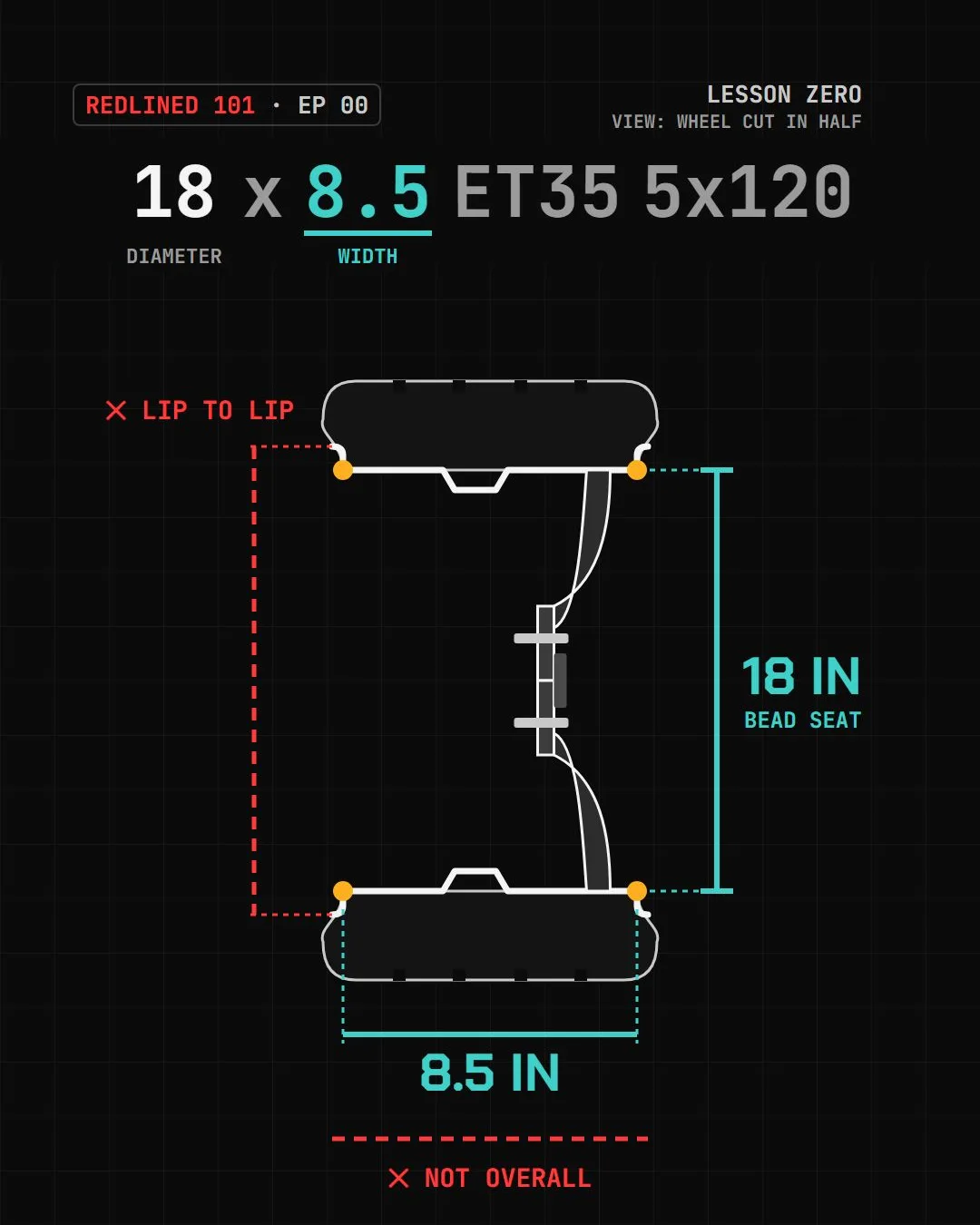
How to Read Wheel Specs: What 18x8.5 ET35 5x120 Means (Redlined 101, Ep 00)
Flip any wheel over and you’ll find a code like 18x8.5 ET35 5x120. Here’s what each number means (diameter, width, offset and bolt pattern), plus the plan for the Redlined 101 series.

Coilovers for Every Budget: BC Racing vs Fortune Auto vs HKS vs Öhlins
What coilovers are, what you can adjust, and the club’s picks from budget to elite (BC Racing, Fortune Auto, HKS and Öhlins), plus a pro tip for a fresh install.
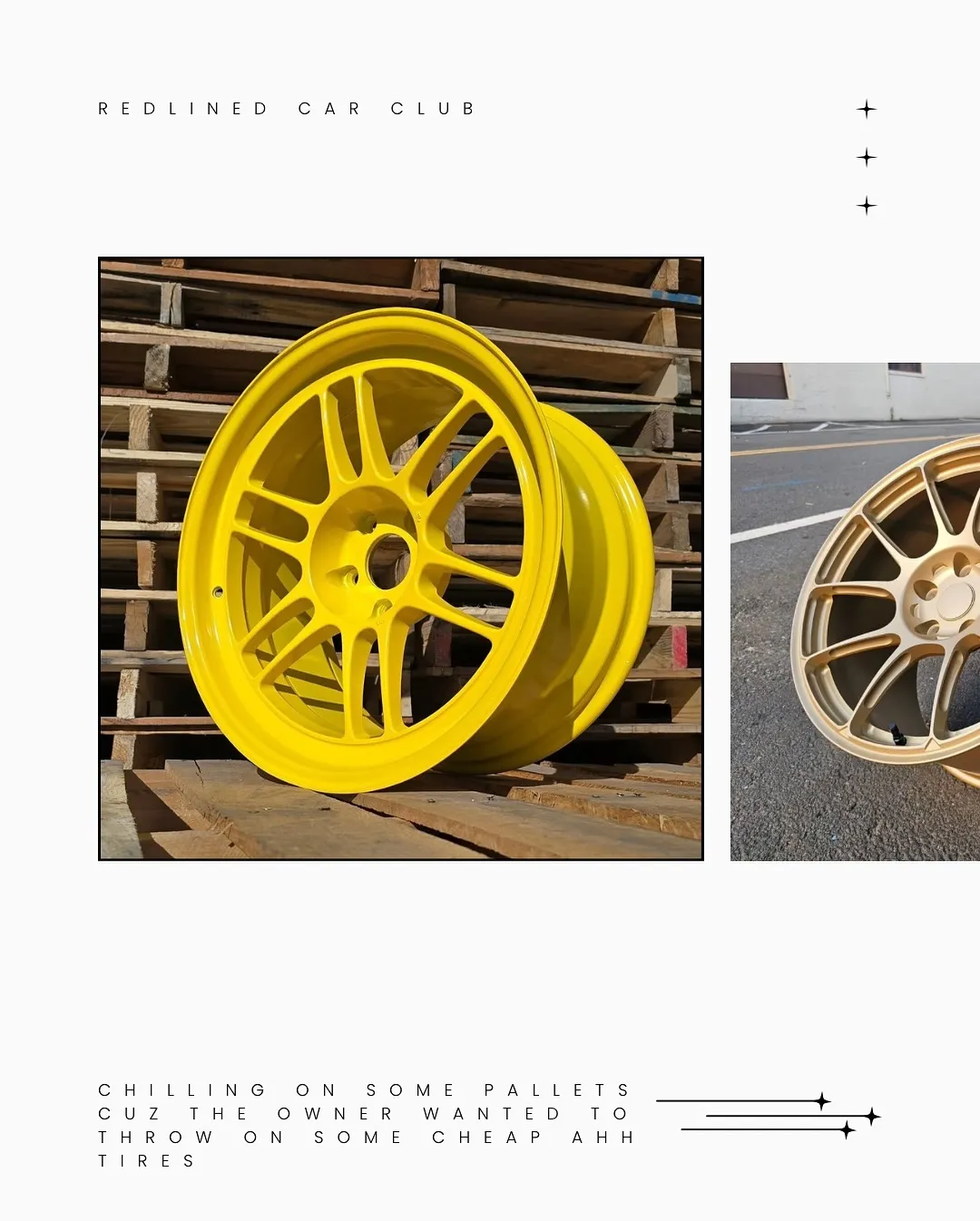
Powder-Coated Wheels: Why the Club Swears by It (and What FAPAUTO Has Been Coating)
Why powder coating beats paint on wheels and calipers, how the work gets done at FAPAUTO in New Jersey, and a look at the wheels and Brembo calipers that have come out of the booth.