
Lowering Springs vs Coilovers vs Air Suspension: Which Should You Run? (Redlined 101, Ep 02)
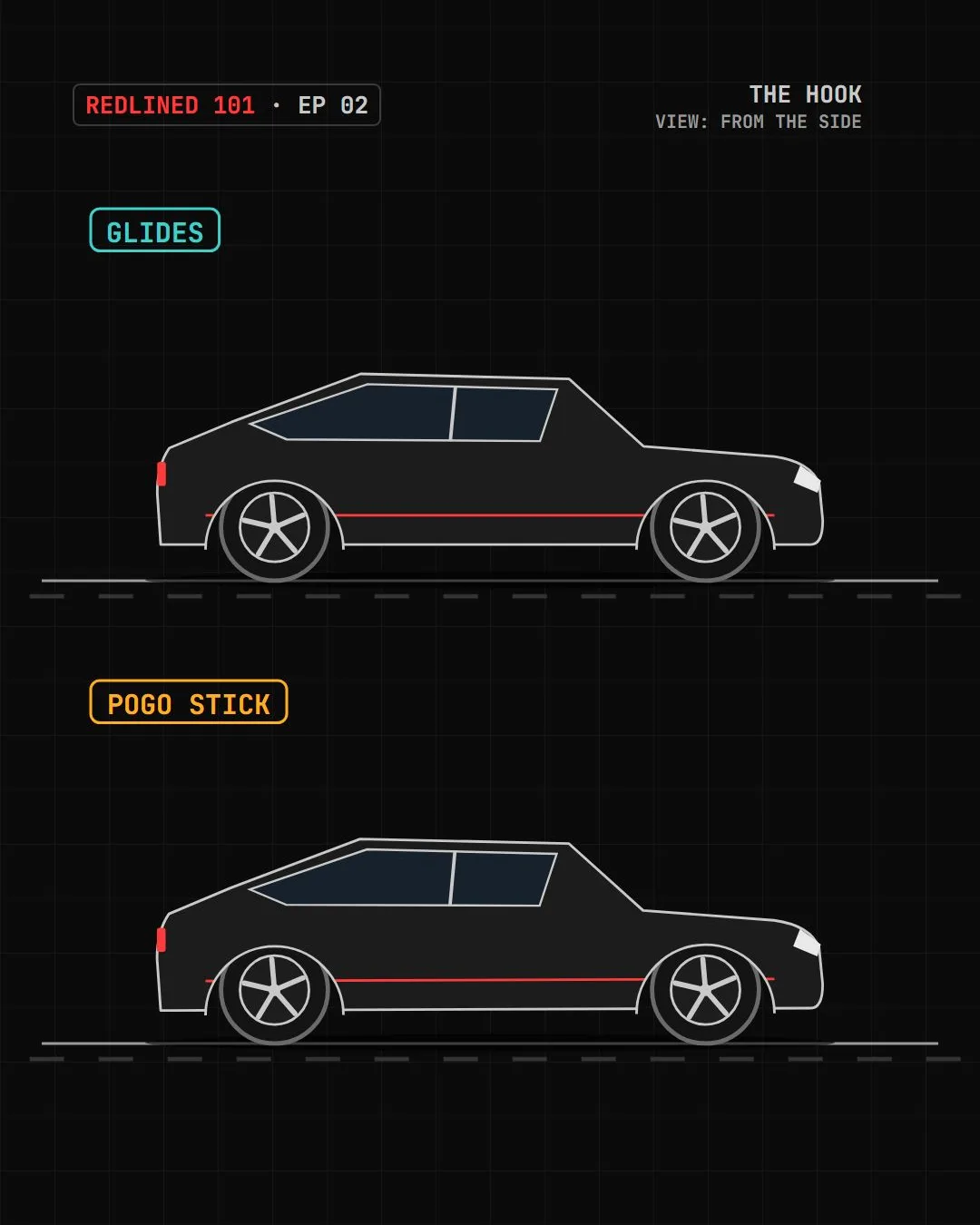
Last episode we set the offset. Now we lower the car. Two cars, same drop, same road: one glides, the other bounces like a pogo stick. Lowering changes everything about how your car rides. Done right, it corners flatter and sits dialed. Done wrong, it crashes over every bump.
Watch Redlined 101, Ep 02 on Instagram →
Two parts do the work
- The spring holds the car up and sets the height.
- The damper, the shock absorber, controls how fast the spring moves.
Springs set the stance. Dampers set the manners.
Option one: lowering springs
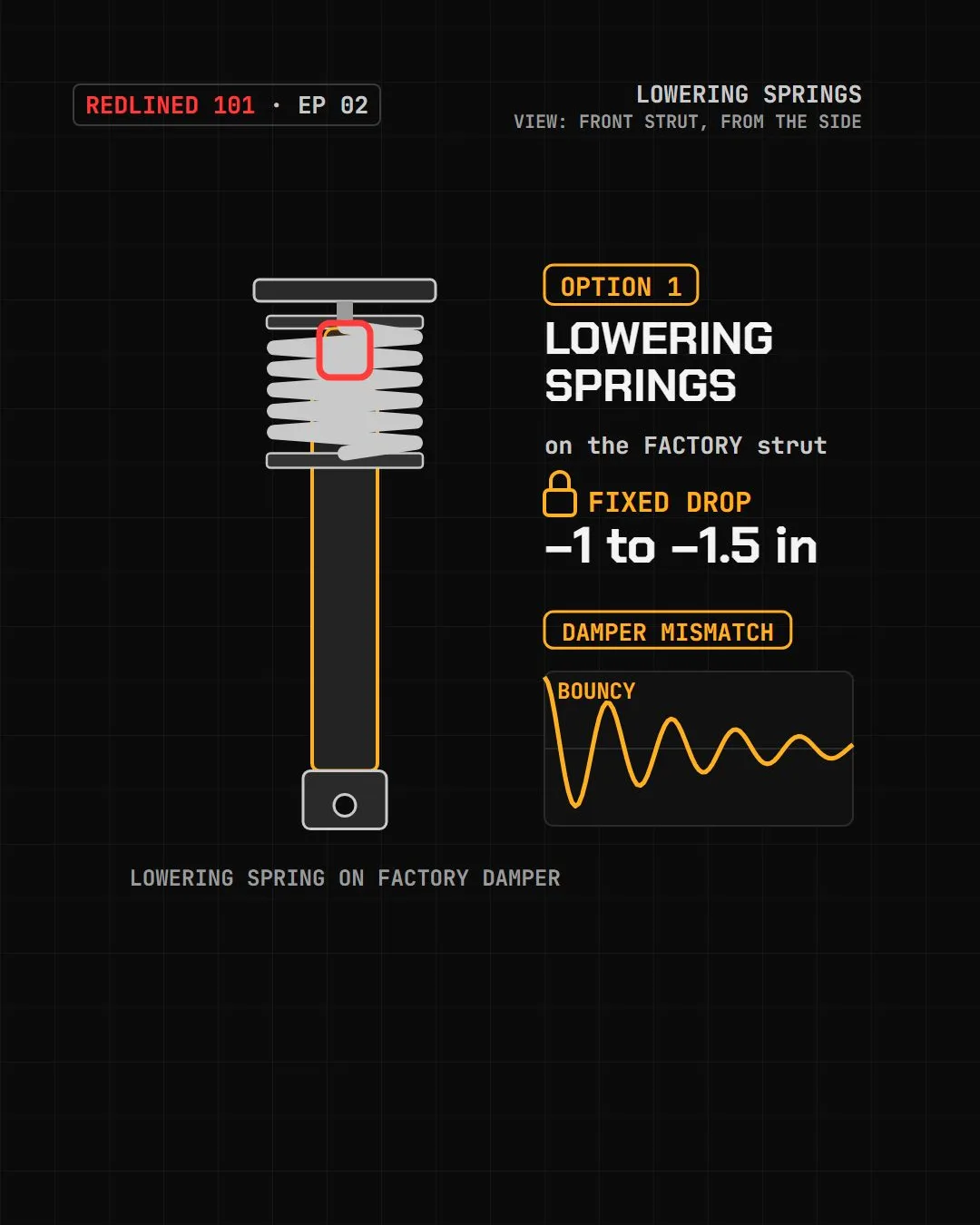
A shorter, stiffer spring bolted onto your factory strut. Fixed drop, roughly an inch to an inch and a half.
But the factory damper was tuned for the old spring, so now it can't keep up. The ride turns bouncy, and big bumps slam the bump stops.
Option two: coilovers
The whole unit gets replaced: spring and damper built together on a threaded body, so you can dial the ride height up or down.
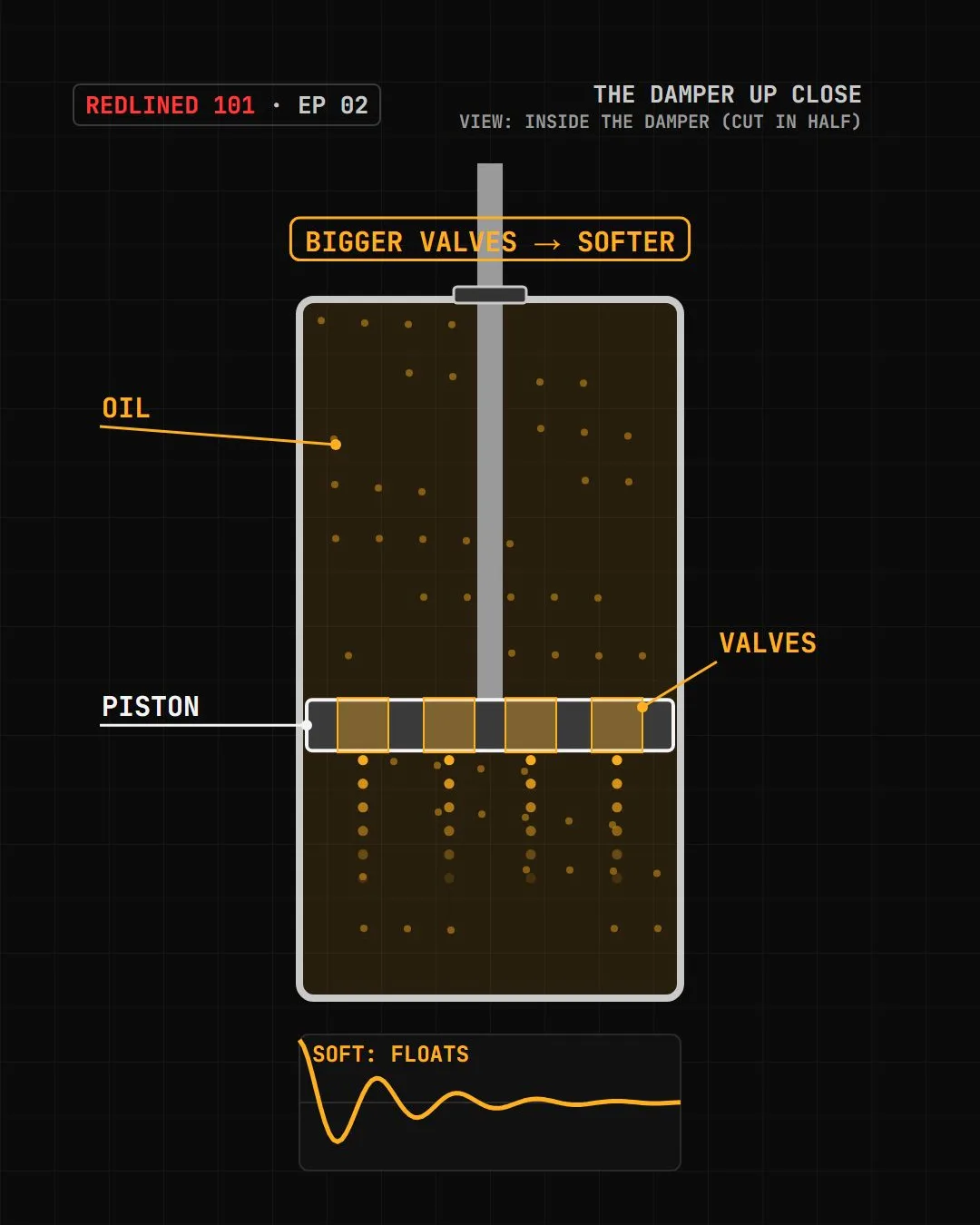
Zoom in on the damper. The piston pushes oil through tiny valves. Smaller valves, firmer ride. Bigger valves, softer ride. That is what controls how fast the spring moves. On a coilover, the damper is valved to match the spring, and many let you adjust the damping. They're tunable, rebuildable, and can be corner-balanced.
Static: set it and live there
Lowering springs and coilovers are both static setups: you set the ride height with tools, align the car, and that's where it lives. It's the purist way, and it's where the cleanest fitment comes from: the height, the wheel offset and the alignment are all measured and dialed in together, once.
The trade-off is that static means committing. Go too low and you'll be scraping driveways, approaching speed bumps at an angle and checking every parking lot entrance before you pull in.
Option three: air suspension
Air suspension replaces the springs with air bags, rubber bellows that hold the car up on pressurized air. A compressor fills a tank, and valves send air to or from each bag, so you can raise or lower the car at the push of a button.
That's the whole appeal: air out to sit the car on the ground at a show, air up to clear driveways, speed bumps and steep ramps. Many kits store height presets and adjust each corner separately.
The catch:
- More parts. Compressor, tank, valve manifold, air lines, fittings and a controller, all of which have to be mounted, wired and protected.
- More money. A complete kit with management usually costs more than springs or coilovers, before installation.
- Leaks to chase. Every fitting is a place air can escape. A well-installed kit is reliable, but it's still a system to maintain, especially through cold winters.
And the ride? A good air kit, with dampers matched to the bags, rides better than most people expect. A cheap one, like cheap coilovers, can ride poorly.
Static or air?
There's no wrong camp, just different priorities. Static suits people who want the purest fitment, the fewest parts and a car that's set and forgotten. Air suits people who want to go as low as possible for shows and still drive the car every day without scraping. Tell us in the comments on the reel which camp you're in.
Trade-offs
Money. Springs cost a couple hundred bucks. Coilovers run from a few hundred dollars for budget kits to a few grand for high-end ones. Air is usually the most expensive of the three. For the club's picks at each budget, see Coilovers for every budget.
Either one installs in an afternoon. And lowering changes your camber and toe, which chews through tires. So either way, get an alignment.
Same drop, real numbers
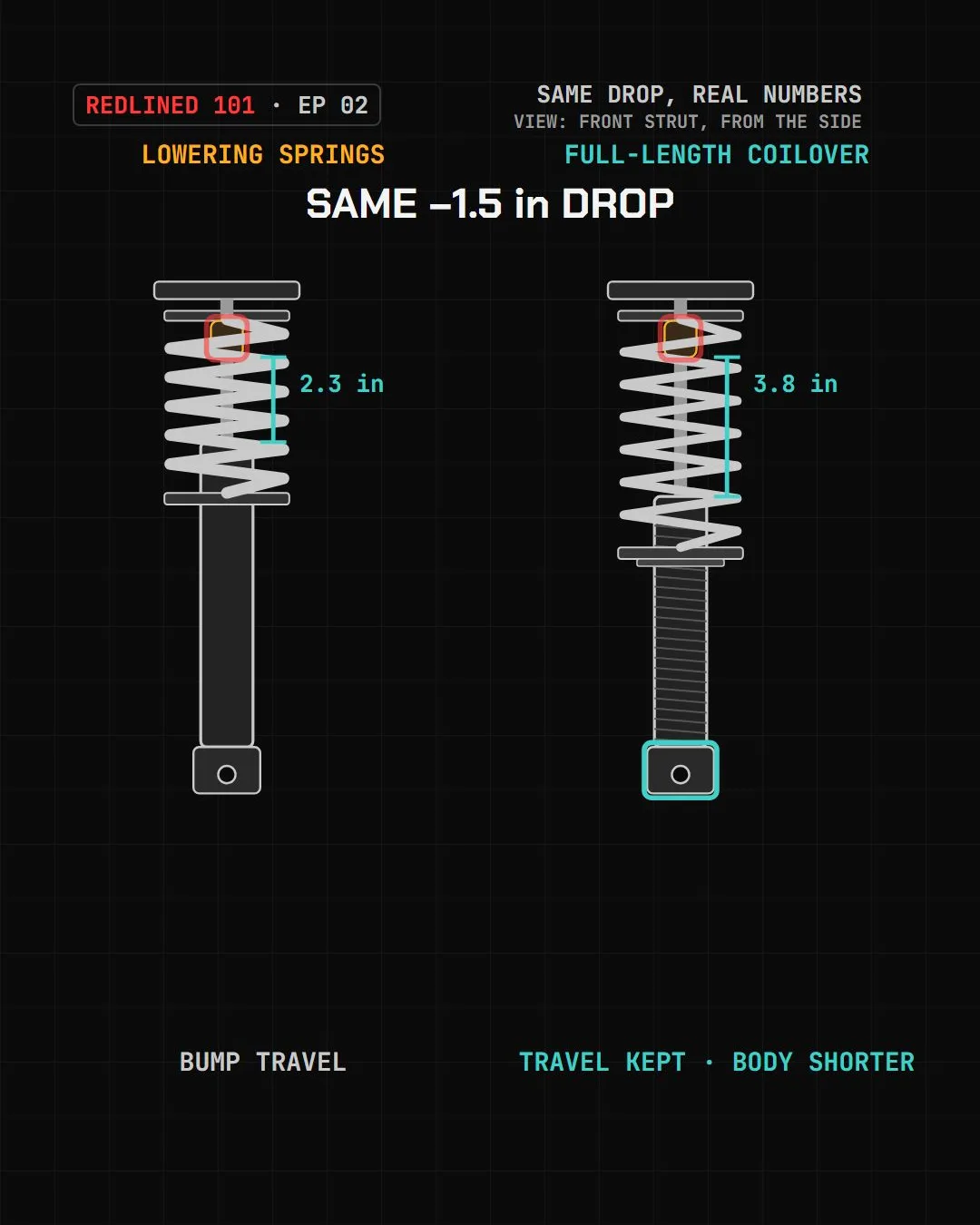
Take the same inch-and-a-half drop. On springs, the strut is the same length, so you lose about that much bump travel. On a full-length adjustable coilover, the body gets shorter and the shock keeps its stroke. Same stance, completely different ride.
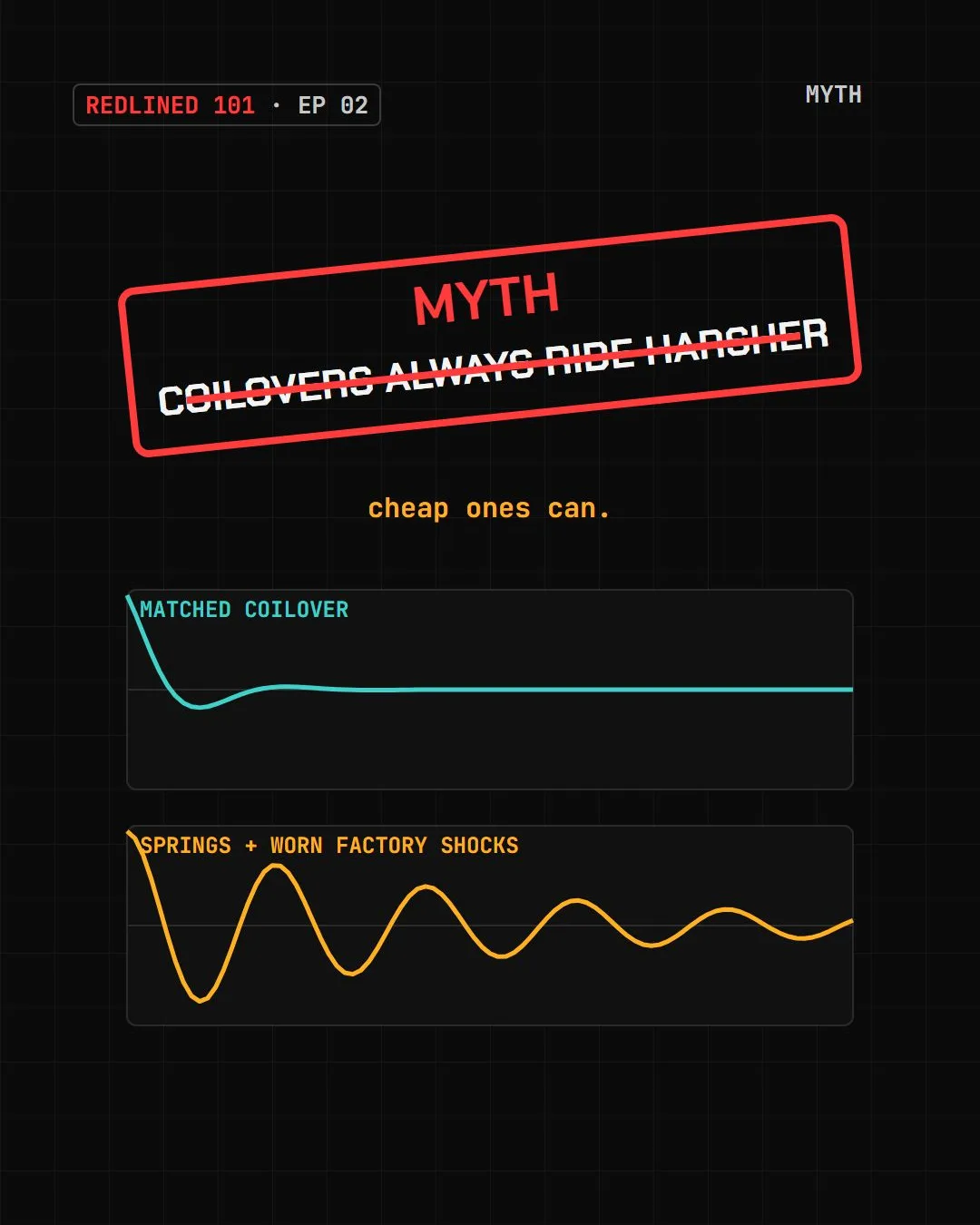
The myth: coilovers always ride harsher
Cheap ones can. But a well-matched coilover rides better than lowering springs on worn factory shocks. Stiff isn't fast. Controlled is fast.
Which one should you buy?
Be honest about how you use the car:
- Daily driver, mild drop, tight budget: quality lowering springs paired with shocks designed for lowered cars. Springs on worn factory shocks is the combination to avoid.
- Daily driver that sees the occasional track day or canyon road: a reputable coilover with damping adjustment. You can soften it for the commute and firm it up for the fun.
- Show car or stance build: coilovers, because you need adjustable height, and often camber plates or adjustable arms to go with them.
- Dedicated track car: good coilovers with spring rates chosen for the car and the tracks, set up with corner balancing and a performance alignment.
What else changes when you lower
A drop is rarely just a drop. Plan for the parts around the springs:
- Bump stops. Factory bump stops sized for factory height can be hit constantly on a lowered car. Many kits include shorter ones.
- Sway bar end links. Lowering changes their angle; adjustable end links put the bar back where it works properly.
- Alignment. Lowering changes camber and toe, and the next episode covers why. Budget for an alignment the same week as the install.
- Clearance. Check the tire against the fender over bumps, and the exhaust and oil pan over driveways and speed bumps.
Signs of a good kit
Look for a manufacturer that publishes spring rates and damper specs, offers rebuilds or replacement parts, and supports the car you drive rather than listing a universal fit. Reviews from owners of the same chassis, on the roads you drive, are worth more than a spec sheet.
Recap
- Springs: cheap, fixed drop. Pair them with shocks built for lowered cars.
- Coilovers: adjustable, matched, pricier.
- Air: adjustable on the fly, more parts and maintenance, usually the most expensive.
Next episode: lowering knocked your alignment out, so we break down camber, toe and caster.
Official merch
Ride height over retirement
Coilovers > 401K – Funny Car Guy on a Unisex Oversized Heavyweight T-Shirt, black
Unisex Oversized Heavyweight T-Shirt
from $32.99
Can't Pump Gas, Can Swap A Motor – NJ Car Guy on a Unisex Oversized Heavyweight T-Shirt, black
Unisex Oversized Heavyweight T-Shirt
from $32.99
Coilovers > 401K – Funny Car Guy on a Washed Unisex T-Shirt, mineral navy
Washed Unisex T-Shirt
from $27.99
Can't Pump Gas, Can Swap A Motor – NJ Car Guy on a Washed Unisex T-Shirt, mineral navy
Washed Unisex T-Shirt
from $27.99
Can't Pump Gas, Can Swap A Motor – NJ Car Guy on a Men's Premium T-Shirt, black
Men's Premium T-Shirt
from $27.99
Coilovers > 401K – Funny Car Guy on a Women's Cropped T-Shirt, black
Women's Cropped T-Shirt
from $28.49
Can't Pump Gas, Can Swap A Motor – NJ Car Guy on a Women's Cropped T-Shirt, black
Women's Cropped T-Shirt
from $28.49
Coilovers > 401K – Funny Car Guy on a Champion Women’s Cropped T-Shirt, black
Champion Women’s Cropped T-Shirt
from $26.99
Can't Pump Gas, Can Swap A Motor – NJ Car Guy on a Champion Women’s Cropped T-Shirt, black
Champion Women’s Cropped T-Shirt
from $26.99
Coilovers > 401K – Funny Car Guy on a Stanley/Stella Blaster Oversized T-Shirt, black
Stanley/Stella Blaster Oversized T-Shirt
from $27.49
Can't Pump Gas, Can Swap A Motor – NJ Car Guy on a Stanley/Stella Blaster Oversized T-Shirt, black
Stanley/Stella Blaster Oversized T-Shirt
from $27.49


Previous: ← Wheel offset explained · Next: Camber, toe and caster explained →
Frequently asked questions
What is the difference between static and air suspension?
Static setups (lowering springs or coilovers) are set to one ride height with tools and stay there. Air suspension uses air bags, a compressor, a tank and valves so you can raise or lower the car at the push of a button.
Does air suspension ride well?
A good air kit with dampers matched to the bags rides better than many people expect. Cheap kits, like cheap coilovers, can ride poorly, and every air system needs leak checks and maintenance.
Do coilovers ride worse than lowering springs?
Not necessarily. Cheap coilovers can ride harshly, but a well-matched coilover usually rides better than lowering springs on worn factory shocks, because the damper is valved for the spring.
Do I need an alignment after lowering?
Yes. Lowering changes camber and toe, which affects handling and wears tires quickly. Get an alignment right after the install.
How much do lowering springs drop a car?
Most lowering springs drop a car roughly an inch to an inch and a half, depending on the car and the kit. The drop is fixed.
Can I put lowering springs on my stock shocks?
You can, but the factory shocks were tuned for the factory springs. The ride often turns bouncy and harsh over big bumps. Shocks built for lowered cars fix that.
More from the club
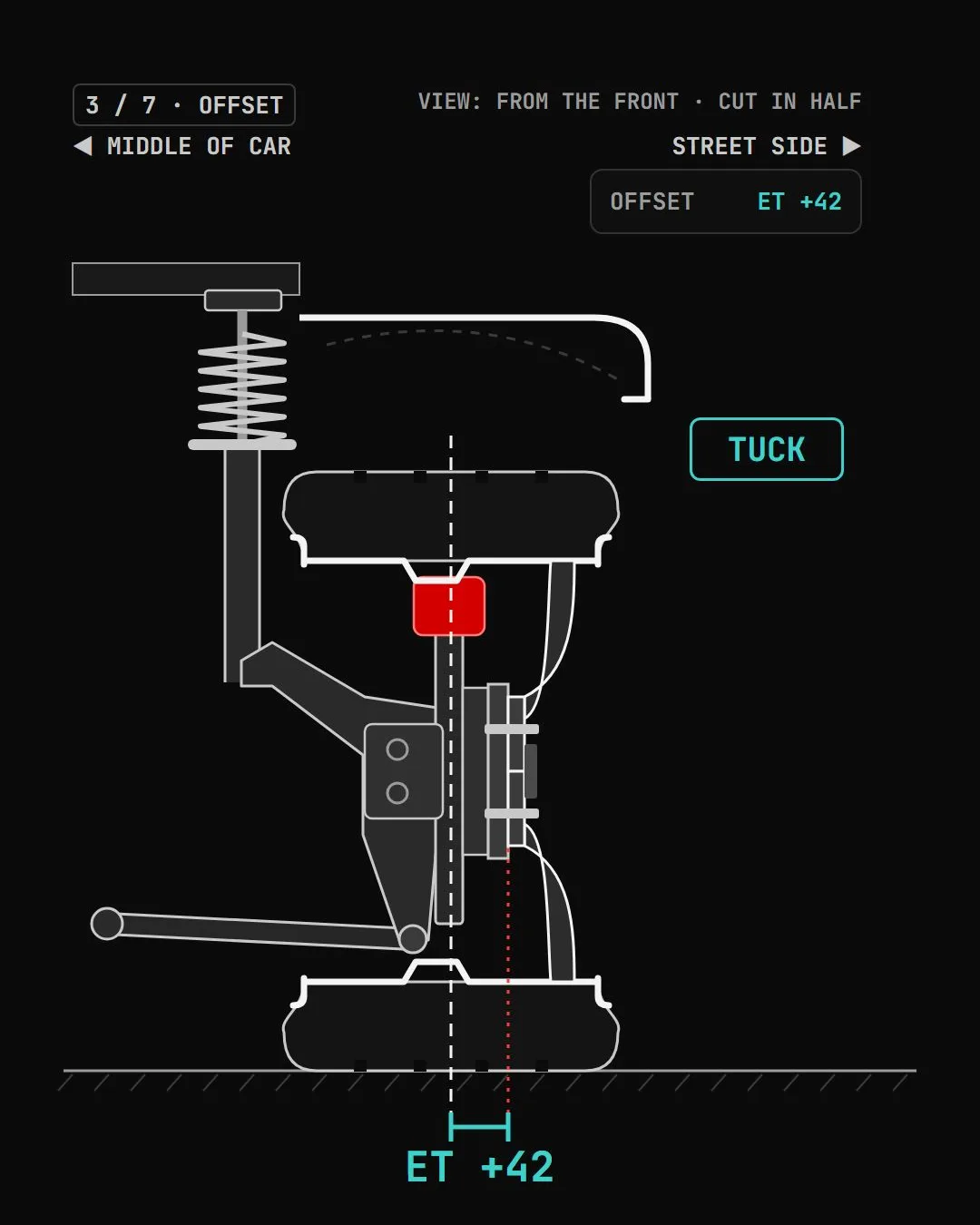
Wheel Offset Explained: ET, Poke, Flush and Tuck (Redlined 101, Ep 01)
What wheel offset (ET) is, why a higher number tucks the wheel and a lower one pokes, how camber and fender rolling change what fits, and what gets respect in the car community.

Coilovers for Every Budget: BC Racing vs Fortune Auto vs HKS vs Öhlins
What coilovers are, what you can adjust, and the club’s picks from budget to elite (BC Racing, Fortune Auto, HKS and Öhlins), plus a pro tip for a fresh install.
Powder Coated Brake Calipers: 5 Reasons to Do It, and How It's Done
Why powder coat your brake calipers: looks, durability, performance, cost and maintenance. Plus how FAPAUTO strips, blasts, coats, bakes and rebuilds them in New Jersey.